Health insurance
eClaimLink explained: how Dubai's health e-claims system works
What eClaimLink is, how eligibility, authorisation, claims and remittance flow in Dubai, the 2025 claims rules, and how it compares with Shafafiya.

Key takeaways
- eClaimLink is the Dubai Health Insurance Corporation's e-claims initiative under the Dubai Health Authority, covering eClaims, ePrescription, eAuthorisation, eEligibility and eReferral.
- Since 1 January 2013, Dubai providers have been required to submit insurance claims for all payers electronically through eClaimLink.
- In October 2025 the Dubai Health Insurance Corporation replaced its earlier claims standards with policy directive PD-05-2025, effective 16 November 2025 according to a law-firm summary.
- Claim rejections tend to fall into a few families, such as eligibility, authorisation, coding, benefit limits and duplicates, and many of them start with policy data.
- NABIDH is Dubai's health information exchange for medical records; it is a separate system from eClaimLink.
eClaimLink is the Dubai Health Authority’s electronic claims system for health insurance. It gives Dubai’s providers, insurers and TPAs (third-party administrators) one shared language and one channel for eligibility checks, prior authorisations, claims, remittance advice and e-prescriptions. Since 1 January 2013, Dubai providers have been required to send insurance claims for all payers electronically through it. This guide explains how the eClaimLink flows work, what changed with the 2025 claims rules, why claims get rejected, and how eClaimLink compares with Abu Dhabi’s Shafafiya.
What eClaimLink is
The Dubai Health Authority (DHA) describes eClaimLink in its 2024 investment guide as “the eClaim initiative of Dubai Health Insurance Corporation”. It has set up a unified healthcare language and communication scheme across the emirate and provides a central system for tracking health data. It carries financial and clinical information between payers, providers, patients and authorities, and gives DHA the information it needs to plan the health system.
The Dubai Health Insurance Corporation (DHIC) is the part of DHA that regulates health insurance. DHA’s guide lists the initiatives within eClaimLink:
- eClaims: claim submission and response.
- ePrescription: electronic prescriptions.
- eAuthorisation and eEligibility: prior approval and membership checks.
- eReferral: referrals between providers.
Who uses it
The users are the providers that bill insurance, and the payers that pay them: insurers and the TPAs that run claims for them. A DHA circular of November 2012 (Circular 35/2012) required all Dubai providers to submit insurance claims for all payers electronically through www.eclaimlink.ae from 1 January 2013. It also required each licensed facility in a group to register separately and submit claims under its own facility ID. DHA’s guide adds that providers and payers complete registration and enrolment once they are licensed by DHA, MOH or DOH.
You will often see a second name next to eClaimLink: DHPO, the Dubai Health Post Office. It is the exchange where transactions are posted and collected. DHIC’s claim standards, for example, required payers to post remittance advice “on DHPO”. In daily use, most people say “eClaimLink” for the whole thing.
The eClaimLink flows, step by step
A typical insured visit in Dubai produces a chain of transactions. Here is the cycle as an insurer or TPA sees it.
- Eligibility. The provider checks that the patient is a covered member on the service date, under the right plan and network. Dubai’s 2025 claims rules, as summarised by Al Tamimi & Company, put weight on patient identity verification.
- Prior authorisation. For services that need approval, the provider sends a request and the payer approves or denies it, with a reason.
- Claim submission. After the service, the provider submits the claim with its coded diagnoses and activities.
- Remittance advice. The payer sends back what it paid, partly paid or rejected, with a denial code for each rejected amount and a payment reference.
- Resubmission. If the provider accepts, nothing more happens. If not, it resubmits. DHIC’s 2019 standard described three resubmission types: a correction, an internal complaint (the start of the internal grievance and appeals process), and a reconciliation once both sides have agreed an outcome.
- Reconciliation. Disputed claims are worked through between provider and payer until the claim is closed.
ePrescription and eReferral run alongside this cycle, so pharmacies and referred-to providers can work from the same record.
The 2025 claims rules: PD-05-2025
For several years, Dubai’s claim timelines came from DHIC standards notices. The best known was SN 03/2019, “Claim Cycle Standardisation”, which set submission, resubmission, remittance and payment deadlines and a maximum of two resubmissions per claim.
That changed in October 2025. DHIC circular GC 04-2025, dated 27 October 2025, announced new policy directives that “revoke and replace” earlier documents. Under PD-05-2025 Dubai Health Insurance Claims Management, it lists the documents replaced, including:
- SN 01-2018 Health Insurance Claims Records
- SN 02-2019 Use of Remittance Advices and Denial Codes
- SN 03-2019 Claim Cycle Standardisation
- PN01-2020 Claim Cycle Standardization
- PD 01-2019 Claims Audit and Recovery in the Emirate of Dubai
- GC05-2018 Updating eClaimLink User Details and GC06-2018 Denial Code Updates
The directive’s own file was not available on the ISAHD site when we checked on 4 November 2026. The clearest public summary we could open is by the law firm Al Tamimi & Company, published 5 November 2025. According to that summary:
| Topic | What the summary says |
|---|---|
| Effective date | 16 November 2025 |
| Who it covers | Insurers, TPAs and providers in Dubai; the Dubai Government Insurance Program is exempt |
| Prior authorisation | Providers request within one hour of the physician’s order; insurers and TPAs respond within 6 hours (elective outpatient), 24 hours (elective inpatient), immediately for emergencies |
| Channel | All claims submitted electronically via eClaimLink; manual or non-electronic submission prohibited |
| Claim cycle | Adjudication within a 141-day cycle |
| Payment | 45 days for initial claims, 30 days for resubmissions |
| Resubmissions | Disputed claims may be resubmitted twice, with structured reconciliation and annual reconciliation sessions |
| Delay fees | 0.03% of the net claimed amount per day for late submission; providers entitled to delay fees for late payment |
| Penalties | Fines from AED 10,000 to AED 50,000 per incident, and possible suspension or revocation of permits |
Because the official text could not be opened, treat these points as a guide and confirm the current directive with DHIC before you change any process.
Why eClaimLink claims get rejected
No regulator figure on rejection rates was available to us, so we will not quote one. What we can do is describe the reasons the regulators’ own denial codes are built around. DHIC’s standards required payers to use the denial codes published on eClaimLink. Abu Dhabi’s published list (in the Shafafiya dictionary) shows how such codes are typically grouped. These are the common families:
- Eligibility. The patient is not a covered member, the service falls outside the cover dates, or the provider is outside the plan’s network.
- Authorisation. Approval was needed and not obtained, the claim does not match what was approved, or the service fell outside the approval’s dates.
- Coding. Diagnosis and procedure codes are missing, invalid, or inconsistent with the patient’s age, gender or the provider type.
- Benefit limits. An annual limit, a sub-limit or a session count has been reached.
- Duplicates. The same service on the same date was already claimed or paid.
- Administrative. Wrong resubmission type, a claim that overlaps an inpatient stay, or a submission outside the contract.
For the insurer, most of these start long before the claim. A member with a wrong date of birth, a plan loaded with the wrong network, or a late registration will turn into eligibility denials months later. That is why policy data quality is a claims issue, not only an underwriting one.
eClaimLink and Shafafiya side by side
| eClaimLink (Dubai) | Shafafiya (Abu Dhabi) | |
|---|---|---|
| Regulator | Dubai Health Authority, through the Dubai Health Insurance Corporation | Department of Health Abu Dhabi |
| What it is | E-claims programme with a shared language, central tracking, and the DHPO exchange | Portal of data exchange standards, plus the Shafafiya Post Office |
| Transactions | eClaims, ePrescription, eAuthorisation and eEligibility, eReferral | Claims, remittance advice, prior request and prior authorisation, person register, e-prescription |
| How you connect | Registration and enrolment on eClaimLink after licensing | Web services only; your own software connects to DOH |
| Code lists | Published on eClaimLink | Published in the Shafafiya dictionary |
| Claim rules | DHIC policy directive PD-05-2025 (effective 16 November 2025, per Al Tamimi & Company’s summary) | DOH standards, business rules and circulars |
In the Northern Emirates, the Ministry of Health and Prevention runs a third exchange: the e-Claims Post Office through Riayati. It carries eligibility checks, authorisations, claim submissions and electronic prescriptions between providers and payers there.
eClaimLink is not NABIDH
The two are easy to mix up. NABIDH is, in DHA’s words, “a health information exchange platform by the Dubai Health Authority that connects public and private Healthcare Facilities in Dubai to securely exchange trusted health information” (DHA EMR transition guideline, 2024). It carries medical records between providers. eClaimLink carries insurance transactions between providers and payers. A Dubai hospital connects to both, for different reasons.
What an insurer’s systems should handle around eClaimLink
The eClaimLink traffic itself usually runs through the claims platform of the insurer or its TPA. The insurer’s core system sits upstream of it and decides much of what happens there. When you review your Dubai medical set-up, look for:
- Clean member data at issue: identity, dates of birth and the Dubai UID, so eligibility checks match.
- Plans that match the DHA-approved product, with the DHA approval code per plan.
- The Essential Benefits Plan (EBP) floor enforced at quote, so no member is priced or covered below the legal minimum.
- Late-registration fines worked out by rule and collected with the premium.
- Continuity certificates in the Dubai format when members move between insurers.
- Claim-utilisation reporting that turns your TPA’s claims data into the format your regulator expects.
How VInsure supports Dubai medical business
VInsure, VIONEX’s insurance core system, does not exchange claims on eClaimLink; claims traffic stays with the TPA or claims platform. VInsure’s Medical module covers the sales and policy side for Dubai members. It works out late-registration fines from a configurable fine matrix that follows DHA and DOH rules, and adds them to the same payment as the premium. It issues continuity certificates in the Dubai and Abu Dhabi formats. In Group Medical, no person can be priced below the DHA Essential Benefits Plan premium on a named staff list, benefit changes must stay within the EBP floor, Dubai approval codes are recorded per plan, Dubai member UIDs are tracked, and the regulated Dubai renewal cap is applied automatically.
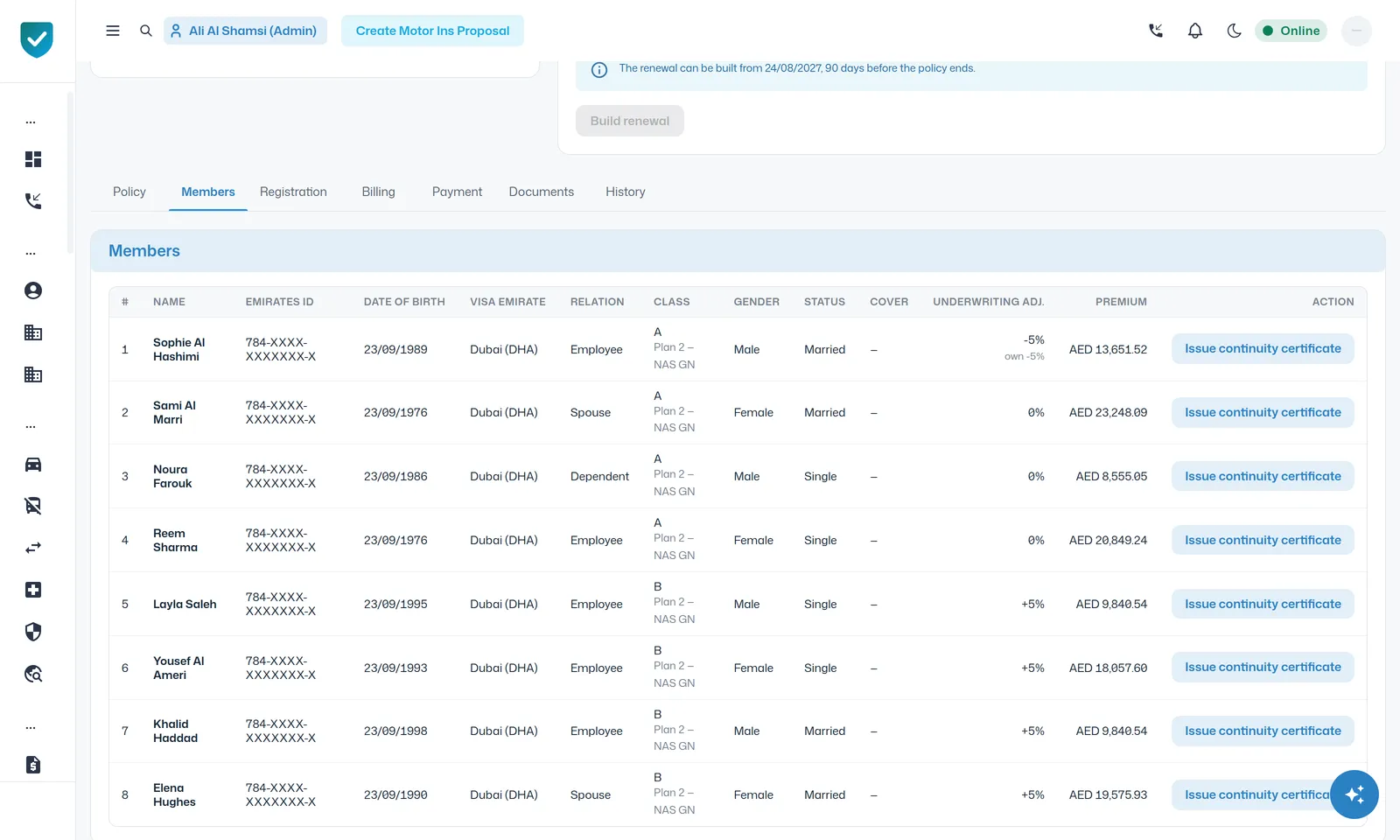 Members on a Group Medical policy, each with a continuity certificate action (demo data).
For claim-utilisation reporting, VInsure converts each network administrator’s claim data into the Central Bank’s file format. To see how this fits with the Abu Dhabi side, read Shafafiya explained. For the regulators behind both systems, see who regulates insurance in the UAE. Or book a demo.
This article describes published regulatory material for general information. Please confirm how any rule applies to your organisation with your compliance or legal team.
Questions people ask
What is the difference between eClaimLink and DHPO?
eClaimLink is the Dubai Health Authority's e-claims programme: the shared language, code sets, rules and portal. DHPO, the Dubai Health Post Office, is the exchange where transactions are posted and collected. Dubai's claim standards, for example, refer to payers posting remittance advice on DHPO. In everyday use, many people say eClaimLink for both.
Who has to register on eClaimLink?
Healthcare providers and payers. A 2012 DHA circular required all Dubai providers that deal with e-claims to register on eclaimlink.ae, with each licensed facility in a group registering separately under its own facility ID. DHA's 2024 investment guide says providers and payers complete registration and enrolment after licensing with DHA, MOH or DOH.
How many times can a Dubai claim be resubmitted?
According to Al Tamimi & Company's summary of the 2025 claims directive, disputed claims may be resubmitted twice, with structured reconciliation and annual reconciliation sessions. Earlier DHIC standards set the same limit of two, and provider-payer contracts could not go above it. Check the current directive with DHIC, as its official file was not available online when this article was written.
Is eClaimLink the same as Shafafiya?
No. They do the same kind of job in different emirates. eClaimLink serves Dubai under the Dubai Health Authority. Shafafiya serves Abu Dhabi under the Department of Health. Each has its own code lists, file formats and rules, so an insurer with members in both emirates works with both.
Where this lives in our products
- MedicalSell, issue and service individual, family and SME group medical cover, with hospital networks as live data and the regulator's checks built into the sale.
- VInsureVInsure runs policies, claims, finance, IFRS 17, brokers and your customer app on one platform for motor, medical and general insurance in the UAE.
- Engine RoomLead routing, callbacks, roles, audit trail, an automation API and an AI assistant run underneath every VInsure product line.
Sources
- Circular #35/2012: E-Claim Program (CIR-2012-SHN0061), Dubai Health Authority (checked )
- Dubai Health Investment Guide 2024, Dubai Health Authority (checked )
- GC 04-2025: DHIC Issuance of Updated Regulations Superseding Previous regulatory documents, Dubai Health Insurance Corporation (ISAHD) (checked )
- eClaimLink Standards Notice 03 of 2019: Claim Cycle Standardisation (since replaced), Dubai Health Insurance Corporation (ISAHD) (checked )
- Dubai Issues Comprehensive Overhaul Of Health Insurance Claims Management Framework, Al Tamimi & Company (via Legal 500) (checked )
- Guideline for Electronic Medical Record Transition in Healthcare Facilities, Dubai Health Authority (checked )
- E-claims post office, Ministry of Health and Prevention (checked )
- Shafafiya, Department of Health Abu Dhabi (checked )
- Codes (Other Codes: Denial), Department of Health Abu Dhabi (checked )
This article explains how things work in general. It is not legal, regulatory, tax or actuarial advice: confirm how a rule applies to your company with your own advisers.

About the author
Tony Naief Al Saiegh, Founder & CEO, VIONEX
Tony was born and raised in Abu Dhabi. He started in design and corporate communications, moved into software eleven years ago, and now leads VIONEX's work on insurance technology for UAE and GCC insurers.