Health insurance
Shafafiya explained: Abu Dhabi's e-claims standards and Post Office
What Shafafiya is, what the Shafafiya dictionary holds, how claims, prior authorisations and remittances move, and what it means for insurers.

Key takeaways
- Shafafiya is the Abu Dhabi Department of Health's portal of data exchange standards and also the Post Office that moves health insurance transactions.
- The Shafafiya dictionary defines the data elements, code sets, XML schemas, licences and denial codes that Abu Dhabi transactions must follow.
- The Post Office has no upload webpage: insurers, TPAs and providers connect their own software to DOH web services.
- A web service called GetPersonInsuranceHistory returns a person's insurance history, which is what continuity checks rely on.
- DOH announces changes on the Shafafiya Notices page, and healthcare entities are required to monitor it.
Shafafiya is the Abu Dhabi Department of Health (DOH) system for health insurance data. It does two jobs: it publishes the standards (the Shafafiya dictionary of data elements, codes and file formats), and it runs the Shafafiya Post Office, the web-service exchange that carries claims, prior authorisations and remittances between providers and payers. If you are an insurer or a TPA (third-party administrator) with Abu Dhabi members, your systems have to speak Shafafiya’s language. This guide explains what the portal holds, how the main transactions flow, and what an insurer’s own systems need to do around it.
What Shafafiya is, in DOH’s own words
DOH describes the Shafafiya portal as the home of “the key standards that govern how healthcare information is exchanged and used”, in line with chapter VIII (Data Management) of its Regulator Policy Manual. The documents on it describe the standard language used to exchange data, such as codes and licences, and the technical specifications of the exchange systems.
DOH also says that any electronic transaction between healthcare entities needs to be structured and exchanged according to these standards. Changes are announced on the Shafafiya Notices page, and Abu Dhabi healthcare entities are required to monitor that page to keep their systems up to date.
The name means “transparency” in Arabic. In practice, people use “Shafafiya” for three things at once:
| What people mean | What it is |
|---|---|
| The Shafafiya portal | The DOH web section with standards, notices, prices, reporting rules and the dictionary |
| The Shafafiya dictionary | The data standard: data elements, code sets, licence lists, schemas and samples |
| The Shafafiya Post Office | The exchange itself, used through web services |
DOH’s portal also sets out the key concepts behind the data. A Patient has an Encounter with a Provider. The Provider claims the charges from the Payer. Each clinical service is an Activity (a consultation, a lab test, a drug), and an Activity can carry Observations, such as a test result. A claim, in DOH’s definition, is “an original request for payment for health services provided to a single Patient”.
The Shafafiya dictionary: what is inside
The Shafafiya dictionary is the page most technical and claims teams bookmark. It is a library rather than a single document. As published today it holds:
- Data elements. The definition of each field used in transactions, plus a release schedule for changes.
- Codes. ICD-10-CM diagnosis codes (several editions are listed), CPT and HCPCS procedure codes, a Drugs code list, LOINC for lab observations, SNOMED CT, an Approved Health Technologies list (September 2026 edition), benefit packages, and an “Other Codes” file.
- The Reference Price List, listed as “All Phases Combined”, updated 21 January 2025.
- Licences. Downloadable lists of licensed insurers, clinicians and facilities in Abu Dhabi, with licensing history, plus DHA and MOH licence lists.
- XSDs (file schemas). Claim Submission, Remittance Advice, Person Register, Prior Request, Prior Authorization, Electronic Prescription, and newer Cost Submission, Common Types and Data Dictionary schemas.
- XML samples for claims (including claims with a DRG, a diagnosis-related group), remittances, person registers, prior requests and pharmacy transactions, with a note on schema restrictions.
- Transactions guidance, including an overview, Prior Request/Authorization notes and the Public Test Environment.
- The Drug and Medical Product Inventory System (DMPIS), marked “NEW” and linked to DOH Circular 58 of 2026.
For anyone searching for “Shafafiya drugs”, the Drugs code list sits under Codes on this page. It is the coded drug list that claims and prescriptions refer to.
Denial codes
The “Other Codes” file includes a sheet called Denial. It lists the standard reasons a payer gives when it rejects or adjusts a request or a claim. Each code has a description and, for many, a worked example. The families include:
| Prefix | Family | Example from the DOH list |
|---|---|---|
| ELIG | Eligibility | ELIG-001 “Patient is not a covered member” |
| AUTH | Authorisation | AUTH-001 “Prior approval is required and was not obtained” |
| BENX | Benefit limits | BENX-005 “Annual limit/sublimit amount exceeded” |
| CODE | Clinical coding | CODE-014 “Activity/diagnosis is inconsistent with the patient’s age/gender” |
| DUPL | Duplicates | DUPL-001 “Authorization request/Claim is a duplicate based on service codes and dates” |
| MNEC | Medical necessity | MNEC-005 “Service/supply may be appropriate, but too frequent” |
| NCOV | Non-coverage | NCOV-001 “Diagnosis(es) is (are) not covered” |
| CLAI | Administrative | CLAI-014 “Claim not compliant with Resubmission type” |
There are also families for prices, submission time limits, co-payments, audits and take-backs. For an insurer, these codes matter twice. Your claims team, or your TPA, has to use them correctly when it denies something. And your reporting needs to read them back, because denial patterns are one of the clearest views of how a medical book is behaving.
How the Shafafiya Post Office works
DOH’s rules for the Post Office are short and worth knowing exactly:
- Senders upload XML files to the Post Office for other organisations (receivers) to collect.
- Each file carries a SenderID and a ReceiverID. Only those two organisations and DOH can see it.
- Each partner must monitor the Post Office for new files sent to them and download them.
- The Post Office uses web services only. There is no DOH webpage or software to upload or download files.
- Users must get their own software to call the web services: a hospital information or billing system, a pharmacy system, an insurance company system, or an XML upload tool.
- DOH does not regulate particular software products.
That last point is why “Shafafiya portal login” is a common search with a confusing answer. There is no claims screen to log in to. Your software logs in, using credentials issued to your organisation. A DOH notice from 2015 also reminds healthcare facilities to change their Shafafiya passwords at three-month intervals, under Circular DG 10/15.
The web services
DOH lists the web services the Post Office offers. In plain terms:
| Web service | What it is for |
|---|---|
| UploadTransaction | Send a file (a claim, a remittance, a person register and so on) |
| GetNewTransactions, DownloadTransactionFile, SetTransactionDownloaded | Find files addressed to you, download them, mark them as collected |
| SearchTransactions | Look up past transactions |
| CheckForNewPriorAuthorizationTransactions, GetNewPriorAuthorizationTransactions | Collect prior authorisation traffic |
| GetPersonInsuranceHistory | Return a person’s insurance history by Emirates ID or Unified ID |
| PersonProfile | Return a person’s demographic details |
| GetPrescriptions | Retrieve electronic prescriptions |
| AddDRGToEClaim, GetDRGDetails | DRG calculation for inpatient claims |
| GetClaimCountReconciliation | Reconcile claim counts |
| GetInsuranceContinuityCertificate, CancelInsuranceContinuityCertificate | Request and cancel insurance continuity certificates (the dictionary marks newer RequestCOC and GetCOCDetails services as test-environment only) |
The main transactions, step by step
For an insurer or TPA, most day-to-day Shafafiya traffic follows one cycle. The schemas named here are the ones DOH publishes in the dictionary.
- Member registration (Person Register). The payer reports its members to DOH. A DOH notice from March 2018, under circular US/05/18, set a process for registering members that uses the PersonProfile web service as the main source of members’ demographic details and requires the Unified ID in PersonRegister transactions.
- Prior request and prior authorisation. Before a planned service that needs approval, the provider sends a Prior Request. The payer answers with a Prior Authorization. DOH’s notes on this transaction include the rule that a DenialCode is mandatory when the authorisation result is “No”.
- Claim submission. After the encounter, the provider sends the claim, with its activities, diagnoses and codes.
- Remittance advice. The payer answers with what it paid, adjusted or denied, line by line, using the denial codes.
- Resubmission. If the provider disagrees or corrects something, it resubmits. The denial list itself has a code for a resubmission that does not match its declared type (CLAI-014).
Shafafiya is also used for reporting beyond insured claims. DOH Circular 109 of 2025 asks licensed providers to report self-pay and non-insurance claims through Shafafiya, with DOH as the Receiver ID. The Reporting page also lists rules such as DG/17/17 on real-time submission of electronic claims.
Prices, notices and keeping up with changes
Shafafiya changes often, and much of the work is simply keeping up. Three pages carry most of the change:
- Prices. The mandatory tariff files, including DRG updates, and material on the Outpatient and Emergency Care Reimbursement Reform (ADOC), with rules and materials for ADOC shadow billing dated September 2026.
- Notices. Dated announcements. Examples include a December 2023 notice on dose, frequency and prescription instructions in pharmacy authorisations and claims, a 2018 notice adding VAT data elements to the PersonRegister and ClaimSubmission schemas, and a 2017 notice on migrating the Shafafiya portal to a new platform. An older notice records that the www.shafafiya.org address was retired from 1 December 2016, so old documents pointing there should be read as doh.gov.ae/shafafiya.
- Dictionary release schedule. Upcoming changes to data elements and validation rules.
DOH offers a Public Test Environment so that entities can test new schemas and validation rules before they go live, and it encourages payers to use it.
Continuity of cover and the insurance history check
One Shafafiya service matters directly to sales and underwriting, not only to claims: GetPersonInsuranceHistory. DOH documents it as taking an Emirates ID or Unified ID and returning the person’s insurance details.
This is the data behind a continuity check. When a new member joins, the insurer wants to know whether the person was insured before, whether there was a gap, and whether they are already insured elsewhere on the start date. Those answers affect waiting periods, pre-existing condition terms and duplicate cover. The DOH denial list even carries a code for waiting periods on pre-existing or specific conditions (AUTH-011), and its worked example turns on “uninterrupted prior coverage”.
What to look for in your own systems
Day-to-day claims traffic on Shafafiya often runs through the claims platform, frequently the TPA’s. But the insurer’s core system feeds that traffic and reads its results. When you review your set-up, look for:
- Members registered correctly from the start. Clean identity data (Emirates ID, Unified ID, dates of birth) at policy issue means fewer eligibility denials later.
- A continuity check at the point of sale, with a clear rule for what happens if the check cannot be completed. “Could not check” should not be treated as “clear”.
- Plan data that matches what the regulator approved, including the DOH approval number per plan.
- Late-registration fines worked out by rule, not by hand.
- Claims data you can report on, including denial codes, by month and by network administrator.
- A named owner for Shafafiya Notices, so that schema and code changes reach your systems on time.
How VInsure handles the Abu Dhabi side
VInsure is VIONEX’s insurance core system. Its Medical module works on the sales and policy side of health insurance, and it uses Shafafiya where that side needs it. For Abu Dhabi members, VInsure runs an insurance-continuity check through the Shafafiya register. In Group Medical, the platform reads the DOH register to see whether a person is already insured elsewhere on the start date. It only reads. “Insured elsewhere” sends the file to an underwriter, “could not check” is not read as clear, and each check writes a history line.
Around that check, VInsure works out late-registration fines from a configurable DOH and DHA fine matrix and collects them with the premium. It issues continuity certificates in the Abu Dhabi and Dubai formats, records the DOH approval number per plan, and produces the ICP (MOI) upload file for Abu Dhabi visa holders. Claims themselves are handled by the network administrator; VInsure converts each administrator’s claim data into the Central Bank’s file format for claim-utilisation reporting. See the Medical page, the integrations in the Engine Room, or book a demo to see it on the live system.
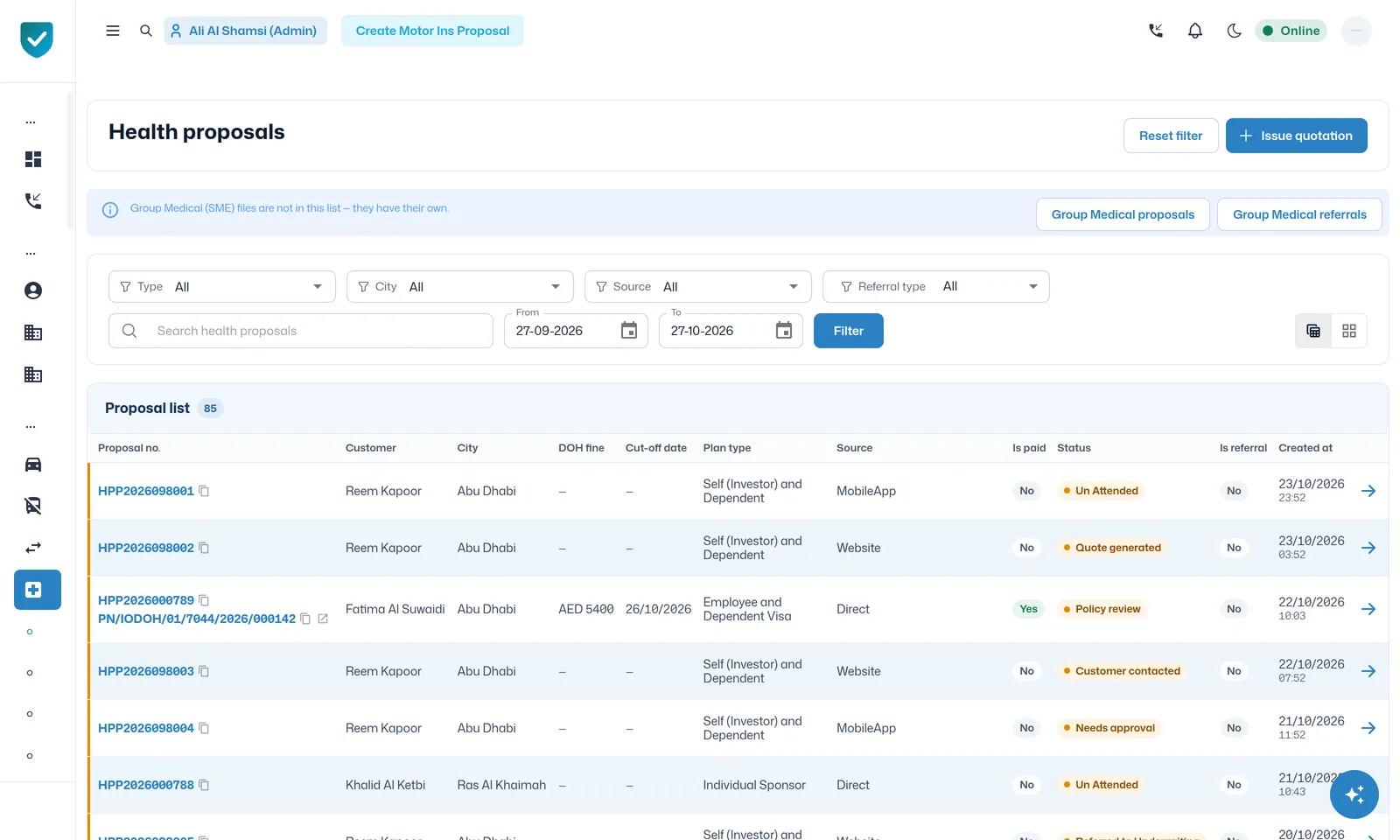 The health proposals worklist, with the DOH fine and cut-off date shown per proposal (demo data).
Where to go next
Shafafiya rewards insurers that treat it as a living standard rather than a one-off integration. Keep the dictionary, prices and notices pages on someone’s weekly list, test changes in the Public Test Environment, and make sure your member data is right before it ever reaches a claim.
If you also write business in Dubai, the next article in this series covers eClaimLink, the Dubai Health Authority’s e-claims platform. For the wider picture of who regulates what, see who regulates insurance in the UAE, and for how a core system ties sales, policies and finance together, see what is a core insurance system.
This article describes published DOH standards for general information. Please confirm how any rule applies to your organisation with your compliance or legal team.
Questions people ask
Is there a Shafafiya login page for submitting claims?
No. DOH states that the Post Office communicates only through web services, with no DOH webpage or software for uploading or downloading files. Your hospital system, billing software, pharmacy system or insurance system connects to the web services using credentials issued to your organisation. DOH does not regulate which software you use.
Where do I find the Shafafiya drugs list?
The Shafafiya dictionary page on doh.gov.ae lists a downloadable Drugs code list under Codes, next to ICD-10-CM, CPT and HCPCS, LOINC and SNOMED CT. DOH has also added the Drug and Medical Product Inventory System (DMPIS), announced with Circular 58 of 2026. Check the dictionary page for the latest version before loading it.
What is a Shafafiya denial code?
A denial code is the standard reason a payer gives when it rejects or adjusts a claim or a prior authorisation. DOH publishes the list in the Other Codes file of the dictionary. Codes are grouped by family, such as ELIG for eligibility, AUTH for authorisation, CODE for clinical coding and DUPL for duplicates.
Does Shafafiya apply outside Abu Dhabi?
Shafafiya is the Abu Dhabi standard. Dubai uses eClaimLink, run under the Dubai Health Authority, and the Northern Emirates have the e-Claims Post Office through the Ministry of Health and Prevention's Riayati platform. An insurer with members in several emirates usually works with more than one of these.
Where this lives in our products
- MedicalSell, issue and service individual, family and SME group medical cover, with hospital networks as live data and the regulator's checks built into the sale.
- Engine RoomLead routing, callbacks, roles, audit trail, an automation API and an AI assistant run underneath every VInsure product line.
- VInsureVInsure runs policies, claims, finance, IFRS 17, brokers and your customer app on one platform for motor, medical and general insurance in the UAE.
Sources
- Shafafiya, Department of Health Abu Dhabi (checked )
- Dictionary - Shafafiya, Department of Health Abu Dhabi (checked )
- WEB SERVICES - Dictionary - Shafafiya, Department of Health Abu Dhabi (checked )
- GetPersonInsuranceHistory - Shafafiya web services, Department of Health Abu Dhabi (checked )
- Prior Request/Authorization - Shafafiya dictionary, Department of Health Abu Dhabi (checked )
- Codes (Other Codes: Denial, Nationality, Observation and more), Department of Health Abu Dhabi (checked )
- Notices - Shafafiya, Department of Health Abu Dhabi (checked )
- Member registration and reporting of Unified ID in PersonRegisters, Department of Health Abu Dhabi (checked )
- Prices - Shafafiya, Department of Health Abu Dhabi (checked )
- Reporting - Shafafiya, Department of Health Abu Dhabi (checked )
- Circular No. 109 of 2025 (reporting of self-pay and non-insurance claims via Shafafiya), Department of Health Abu Dhabi (checked )
- E-claims post office, Ministry of Health and Prevention (checked )
This article explains how things work in general. It is not legal, regulatory, tax or actuarial advice: confirm how a rule applies to your company with your own advisers.

About the author
Tony Naief Al Saiegh, Founder & CEO, VIONEX
Tony was born and raised in Abu Dhabi. He started in design and corporate communications, moved into software eleven years ago, and now leads VIONEX's work on insurance technology for UAE and GCC insurers.