Core systems
What is a core insurance system? A guide for UAE and GCC insurers
What an insurance core system does, which modules it includes, how it differs from ERP and CRM, and what UAE and GCC insurers need from one.

Key takeaways
- An insurance core system is the main system an insurer runs policies, claims and money on: quoting, underwriting, issue, servicing, claims, billing and the accounting entries behind them.
- UAE and GCC insurers need local capabilities that international definitions skip: Arabic right to left, Emirates ID and Mulkiya documents, traffic and health authority links, Takaful funds and UAE VAT.
- A core system is not an ERP or a CRM. It holds the insurance contract itself, and the ERP and CRM sit around it.
- The clearest sign you have outgrown your core is re-typing: the same data keyed into several systems, and finance rebuilding the month by hand.
An insurance core system is the main system an insurer runs its business on. It holds the policy from the first quote to the last renewal, the claims made against it, and the money that moves because of both: premiums, commission, claim payments, refunds and reserves. If the core system stopped for a day, the insurer could not sell, service or pay.
That is the short answer most definitions give. What they leave out is that a core system for a UAE or GCC insurer has to do a lot of local work. It has to read an Emirates ID and a Mulkiya (the UAE vehicle registration card), print a policy in Arabic, talk to traffic and health authority services, apply UAE VAT, and keep Takaful funds apart if the insurer is a Takaful operator. This guide explains what an insurance core system is, what it contains, how it differs from the other systems around it, and the signs that yours is holding you back.
What an insurance core system does
Think of the life of one motor policy. A customer asks for a price. Someone checks the driver and the car, prices the risk and issues the policy with its documents. During the year the customer changes the car or adds a driver. Then there is an accident, a survey, a repair or a cash settlement. At the end, the policy renews or lapses. Behind each step, money moves and an accounting entry is needed.
A core insurance system is the place where all of that is recorded as one connected story. In practice it does six jobs:
- Policy administration. Products, plans, rates, underwriting rules, quotes, issue, endorsements (changes to a live policy), renewals and cancellations.
- Billing and collections. Who owes what, payment links and receipts, instalments, credit terms and refunds.
- Claims. First notice of loss, reserves, surveys, repairs, approvals, payments, salvage and recovery from other parties.
- Finance. The accounting entries that each business event creates, VAT, reinsurance and the base for reporting.
- Distribution. Brokers, agents and aggregators, what each may sell, and their commission.
- Portals and channels. The views that customers, brokers, garages, surveyors and other partners use to work with the insurer.
Older systems often covered only the first job well. The rest grew up around them as separate tools, spreadsheets and email.
The modules of a core insurance system
Vendors package modules differently, but the building blocks are similar. This table is a practical checklist of what a complete core system for a UAE insurer usually covers.
| Area | What it covers | Who uses it |
|---|---|---|
| Products and pricing | Plans, benefits, rate tables, excess bands, discounts, valuation rules | Underwriters, product managers |
| Sales and underwriting | Quotes, document checks, referrals outside the rules, approvals | Sales staff, underwriters |
| Policy servicing | Endorsements, renewals, cancellations, certificates and letters | Operations, customer service |
| Customers | One record per person or company, KYC (know-your-customer) files | Compliance, sales, service |
| Claims | Claim intake, reserves, surveys, repair or cash decisions, payments | Claims handlers, surveyors, finance |
| Partners | Garages, loss adjusters, contractors, salvage buyers | Partners in their own portals |
| Distribution | Broker onboarding, product rights, limits, commission, broker API | Distribution team, brokers, aggregators |
| Finance | Ledger entries, VAT, collections, payouts, reinsurance, close | Finance, actuaries, auditors |
| Customer channels | App, website, online buying, renewals, claim tracking | Customers |
| Platform | Roles, permissions, audit trail, notifications, integrations | IT, compliance, management |
Few insurers need all of these rows on day one. But each row you leave outside the core becomes a place where data is typed twice.
Why UAE and GCC insurers need local capabilities
International definitions of an insurance core system are written for markets with different documents, different regulators and different languages. Here is what a core system for this region has to handle.
Regulation and supervision
Insurance in the UAE is supervised by the Central Bank of the UAE (CBUAE). Since January 2021, the Central Bank and its Board have replaced the former Insurance Authority in all its competencies, under Federal Decree-Law No. 25 of 2020. For the wider picture, see our guide on who regulates insurance in the UAE.
Rules change how the system must behave. A small example: under the CBUAE’s Insurance Brokers’ Regulation, premiums on primary insurance are paid by clients directly to the insurer, and brokers may not collect them. A core system that sends the customer a payment link, and records which broker introduced the business, fits that rule naturally.
Arabic, right to left
Policies, certificates, letters, the customer app and partner portals need to work in Arabic as well as English. Right-to-left layout is not a translation job you add at the end. Tables, numbers, dates and mixed-language fields all have to read correctly.
Local documents
Most UAE motor and medical business starts with documents: the Emirates ID, the driving licence, the Mulkiya, a trade licence for companies. A core system that reads these documents and fills the proposal saves staff from re-typing, and catches mismatches early. We cover how this works in reading Emirates ID and Mulkiya automatically.
Government and authority links
Motor business depends on traffic authority data and national vehicle and driver records. Health business depends on the emirate health authorities: according to the UAE Government portal, employers must buy health insurance for private-sector employees and domestic workers before a residence permit is issued or renewed. The rule began in Abu Dhabi and Dubai and, since 1 January 2025, extends to the other emirates. In Abu Dhabi, insurers also check a member’s cover history through the Department of Health’s Shafafiya services (see Shafafiya explained).
Takaful funds
Many UAE insurers are Takaful operators. Under Takaful, participants pay contributions into a participants’ account that pays claims, and the operator manages it for a fee (the Central Bank’s broker regulation defines it in these terms). The core system has to tag each accounting line to the right fund, book the operator’s Wakala fee, and produce trial balances per fund. Our Takaful explainer covers the model.
Tax and reporting
The Federal Tax Authority’s insurance VAT guide sets the general principle that insurance and related services are subject to VAT at the standard rate, with limited exceptions. E-invoicing is next: the Ministry of Finance requires businesses in scope with annual revenue of AED 50 million or more to implement the e-invoicing system by 1 January 2027. And IFRS 17, the accounting standard for insurance contracts, has applied to annual periods beginning on or after 1 January 2023. All three depend on clean, policy-level data from the core.
These are descriptions of rules, not advice. Confirm how each one applies to your company with your compliance, legal and tax teams.
Core system vs ERP vs CRM
Insurers often ask whether their ERP or CRM can do the job. They solve different problems.
| Core insurance system | ERP | CRM | |
|---|---|---|---|
| Main object | The insurance contract and its claims | The company’s own finances and resources | The relationship and the sales pipeline |
| Knows about | Plans, rates, endorsements, reserves, commission, Takaful funds | Payroll, procurement, fixed assets, general accounts | Leads, contacts, callbacks, campaigns |
| Typical gap if used alone | Not built for payroll or procurement | Does not understand an endorsement or a reserve | Cannot issue or price a policy |
The healthy set-up is a core system that creates the insurance entries itself as business happens, with an ERP and a CRM around it where needed. The unhealthy set-up is a core that holds policies while claims, brokers and finance live elsewhere and meet only in a month-end spreadsheet.
Signs you have outgrown your core system
Most insurers do not decide to replace a core system on a quiet afternoon. They notice the cost of working around it. Common signs:
- The same data is typed more than once. A proposal is keyed from paper, then again for the policy, then again by finance.
- Claims and garages run on email and spreadsheets. Nobody can answer “where is this repair?” without phoning someone.
- Brokers sit in a separate tool, and commission is reconciled by hand.
- Month end is a rebuild. Finance assembles the books from exports instead of reviewing entries that already exist.
- Simple changes need developers. A new plan, a new rate band or a new approval limit becomes an IT ticket.
- Arabic is an afterthought, handled by separate templates or manual edits.
- Regulators and auditors take weeks to satisfy, because no single place shows who changed what, and when.
If several of these sound familiar, the problem is usually not one module. It is that the business has grown around the core instead of inside it. A companion guide on how to choose a core insurance system turns these signs into an evaluation checklist.
What to look for in a modern insurance core system
Whichever vendor you speak to, look for a few qualities:
- One set of data. Sales, claims, partners and finance share the same records, so a policy, its claims and its money are one story.
- Configuration your teams own. Pricing tables, plans, approval limits, document checks and deadlines should be settings with a change history, not code.
- A door for each partner. Brokers, garages, surveyors and customers each see their own work in their own view.
- Accounting written by the business events. Each policy issued or claim paid should create its own balanced entry.
- Local depth. Arabic, UAE documents, authority links, VAT and Takaful funds are ready, not promised.
- A way to move without a big bang. The system should run beside your current one and take over area by area.
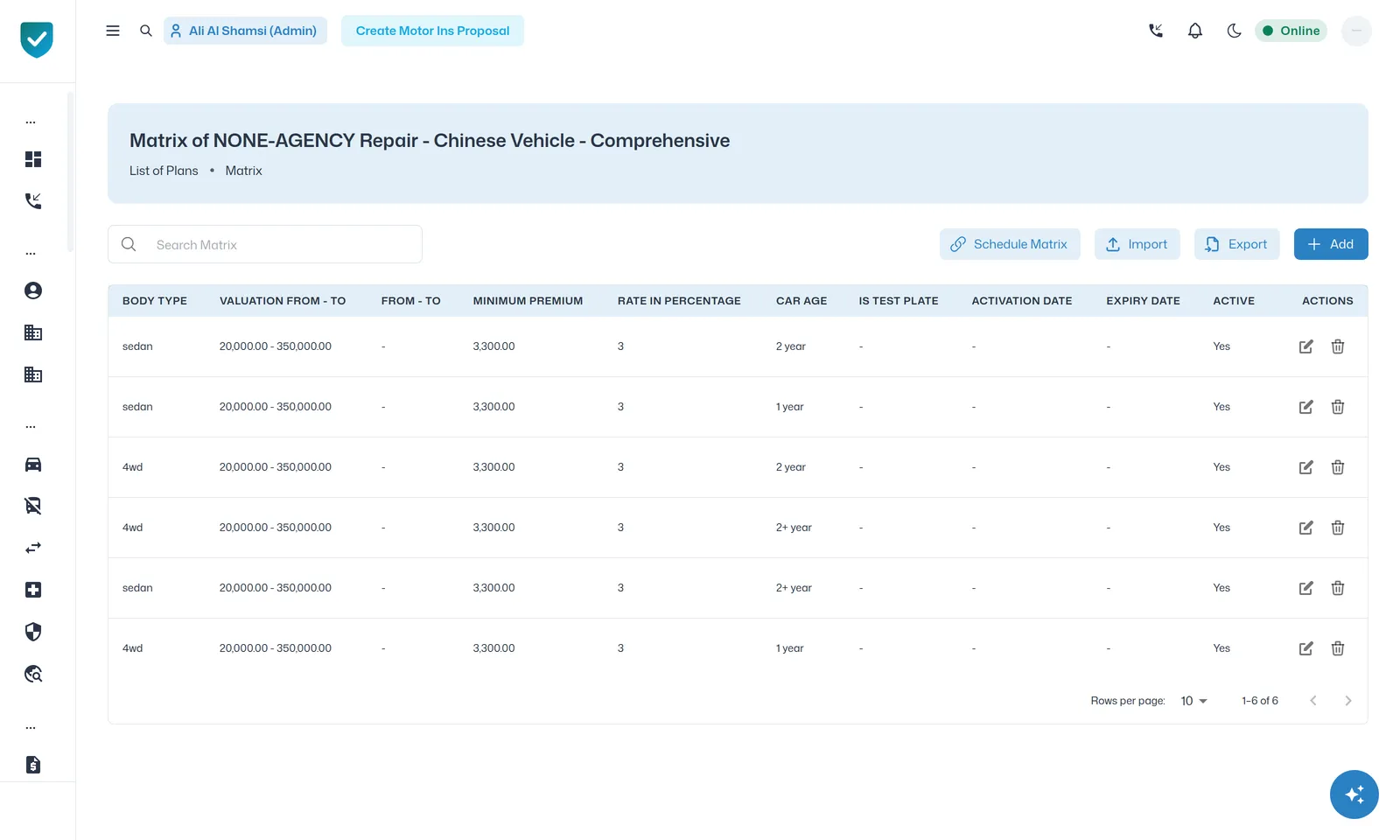 A motor plan’s rate matrix that underwriters edit themselves, with import, export and scheduled changes (demo data).
How VInsure approaches the core
VInsure is VIONEX’s insurance core system, built in Abu Dhabi around UAE rules. It runs motor, medical and general lines on one platform, covering sales and underwriting, claims and garages, finance and reinsurance, brokers and customers, and the insurer’s own app and website. English and Arabic run throughout, right to left. It connects to traffic authorities, the national ID service, health authorities and UAE payment gateways. Its ledger is Takaful-aware and applies UAE VAT, and the Central Bank complaint deadlines are built into the complaints queue. Pricing tables, approval limits, document checks and routing rules are settings the insurer’s teams control.
It is in production: Methaq Takaful runs its daily business on VInsure, and an implementation has started with an insurer in Kuwait. To see how one policy moves through the whole platform, take the 2-minute tour. If you are weighing a move from a legacy core, switching to VInsure explains how it goes live module by module beside the systems you already have.
Questions people ask
What is the difference between a core insurance system and a policy administration system?
A policy administration system handles the policy itself: quoting, issuing, endorsements, renewals and cancellations. A core insurance system is usually the wider platform, with policy administration at its centre plus claims, billing, accounting entries, distribution and customer portals. Some vendors use the two terms for the same thing, so ask exactly which modules are included.
Do UAE insurers need a locally built core system?
Not necessarily, but they need local capabilities. That means Arabic right to left in documents and portals, reading Emirates IDs and vehicle registration cards, links to traffic and health authority services, UAE VAT on documents, and Takaful fund accounting if you are a Takaful operator. Check how much of this is ready on day one and how much is a custom project.
Can a core insurance system replace our ERP?
Usually not entirely. The core system writes the insurance side of the books: premiums, commission, claims, reserves and refunds. Many insurers keep an ERP for payroll, procurement and fixed assets. What matters is that the insurance entries are created by the business events themselves and not re-keyed into the ERP at month end.
How long does it take to replace a core insurance system?
It depends on the lines of business, the number of modules and the order you choose. Insurers that go live module by module, running the new system beside the old one, spread the risk over several smaller steps instead of one large cutover. Any vendor quoting a fixed duration before understanding your book should explain how they arrived at it.
Where this lives in our products
- VInsureVInsure runs policies, claims, finance, IFRS 17, brokers and your customer app on one platform for motor, medical and general insurance in the UAE.
- The 2-minute tourA two-minute walk through VInsure: quote, underwriting, issue, claims and renewal for one motor policy, as your team and customers see it.
- Switching to VInsureMove from a legacy core system to VInsure module by module, running beside the systems you have, with no big-bang cutover. Common questions answered.
- Finance & IFRS 17An insurance general ledger inside the platform. Policies and claims post their own entries, with reinsurance (retakaful) and IFRS 17 built on top.
Sources
- Decretal Federal Law No. (25) of 2020 Regarding the amendment of some provisions of the Decretal Federal Law No. (14) of 2018 regarding the Central Bank & Organization of Financial Institutions and Activities, Central Bank of the UAE (CBUAE Rulebook) (checked )
- Insurance Brokers’ Regulation (C 1/2024), Central Bank of the UAE (CBUAE Rulebook) (checked )
- Getting a health insurance, The Official Platform of the UAE Government (u.ae) (checked )
- Insurance VAT Guide (VATGIN1), Federal Tax Authority (checked )
- Ministry of Finance announces targeted amendments to eInvoicing system decisions, Ministry of Finance, UAE (checked )
- Ministerial Decision No. 244 of 2025 on the Implementation of the Electronic Invoicing System, Ministry of Finance, UAE (checked )
- IFRS 17 Insurance Contracts, IFRS Foundation (checked )
This article explains how things work in general. It is not legal, regulatory, tax or actuarial advice: confirm how a rule applies to your company with your own advisers.

About the author
Tony Naief Al Saiegh, Founder & CEO, VIONEX
Tony was born and raised in Abu Dhabi. He started in design and corporate communications, moved into software eleven years ago, and now leads VIONEX's work on insurance technology for UAE and GCC insurers.