Finance & takaful
Takaful insurance explained: how it works and what systems need
What takaful insurance is, how it differs from conventional insurance, the Wakala model, Qard Hasan, surplus and UAE rules, and what systems must track.

Key takeaways
- Takaful insurance is cooperative cover: participants donate contributions to a fund that pays their claims, and the takaful company manages that fund for a fee.
- Under the Central Bank's Regulation Regarding Takaful Insurance (in force from 14 September 2026), the operating model must be based on a Wakala contract, and the fund's assets and liabilities must be completely separate from the company's.
- If the fund runs short, the company must lend it a Qard Hasan (an interest-free loan), which it can recover only from later surplus.
- For systems, takaful means two sets of books in one ledger: each line tagged to its fund, the Wakala fee booked between funds within the cap, and a trial balance per fund.
Takaful insurance is insurance built on cooperation rather than a sale of risk. Participants donate their contributions to a shared takaful fund, the fund pays the claims of its members, and the takaful company runs the fund for a fee agreed in advance. In the UAE, the Central Bank’s Regulation Regarding Takaful Insurance, in force since 14 September 2026, requires that model to be based on a Wakala (agency) contract, with the fund kept completely separate from the company’s own money.
This guide explains takaful in plain words for insurer teams in the UAE: how it differs from conventional insurance, the main models, the two funds, Qard Hasan, surplus, retakaful and Sharia supervision. It ends with what all of this asks of your core system and your ledger, because takaful rules are only as good as the books that prove them.
What is takaful insurance?
The word takaful comes from the Arabic for mutual guarantee. The Central Bank regulation defines takaful insurance as a scheme to achieve solidarity and cooperation among a group of participants, where each one makes a contribution to the takaful fund on the basis of tabarru (donation), and the fund bears the responsibility of paying compensation.
Three parties matter:
- Participants, who pay contributions (the takaful word for premium) and are covered by the fund.
- The takaful fund, which owns the donated contributions. Under the UAE regulation it has its own legal personality and financial liability, independent from the company that set it up.
- The takaful company (the operator), which manages the fund as its agent and is paid a Wakala fee for doing so. The shareholders’ capital sits with the company, not in the fund.
The regulation also makes the company accountable to customers: the company is the party that claims are enforced against, even though the money to pay them comes from the fund’s assets.
Takaful vs conventional insurance
The cover a customer buys can look the same. A motor or medical policy from a takaful company protects against much the same events. The difference is in who owns the money, who keeps any profit from underwriting, and how the operator is paid.
| Takaful insurance | Conventional insurance | |
|---|---|---|
| What the customer pays | A contribution, donated to the takaful fund | A premium, paid to the insurer |
| Who carries the risk | The participants, through their shared fund | The insurer and its shareholders |
| How the operator earns | A Wakala fee for managing the fund, plus any approved share of surplus | Underwriting profit and investment income |
| Underwriting surplus | Belongs to the fund; distributed under an approved surplus policy | Belongs to the shareholders |
| If claims exceed the fund | The company lends the fund a Qard Hasan (interest-free loan) | The insurer pays from its own capital |
| Investments | Sharia-compliant only | Any permitted investment |
| Oversight of principles | An internal Sharia supervision committee, under the Higher Sharia Authority | No Sharia layer |
Takaful models: Wakala, Mudaraba and hybrid
Around the world, takaful operators have used three main ways to get paid:
- Wakala (agency). The operator charges a fee, usually a percentage of contributions, for managing the fund. Surplus stays with the participants.
- Mudaraba (profit sharing). The operator acts as investment manager and takes an agreed share of the investment profit of the fund instead of, or as well as, a fee.
- Hybrid. A Wakala fee for running the insurance side, and a Mudaraba share of investment returns. The 2014 financial regulations for takaful companies (Insurance Authority Board Decision No. 26 of 2014, now kept in the Central Bank rulebook) describe this choice: Wakala fees as a percentage of contributions and Mudaraba fees as a percentage of investment income, or a Wakala-only model.
In the UAE today, the direction is clear. Article 6 of the Central Bank’s Regulation Regarding Takaful Insurance says the operating model must at all times be based on a Wakala contract. Article 18 applies this to both kinds of business: property and liability, and insurance of persons and fund accumulation (family takaful). For family takaful, the investment part of the contribution goes to a separate participants’ investment account, managed under a Wakala bi al-istithmar (investment agency) contract.
The detailed Standard Re the Operational Model of Takaful Insurance, which the rulebook shows as effective from 15 July 2027, sets the rules for the Wakala fee. It must be clearly defined in advance, based on a technical study, stated in the participation membership policy and approved each year by the internal Sharia supervision committee. It must not exceed the maximum set by the Central Bank. The rulebook still lists Article 3 of the 2014 financial regulations as in force, and it caps Wakala and Mudaraba fees charged to participants at 35% of gross written contributions and participants’ investment revenue for the year. Ask your finance and compliance teams which cap applies to each product.
The participants’ fund and the shareholders’ fund
Fund separation is the heart of takaful accounting. The regulation is strict about it:
- The fund’s assets and liabilities must be completely separate from the company’s (Article 18.4).
- Family takaful and general takaful are separated too. A company writing both must keep insurance of persons and fund accumulation apart from property and liability insurance, technically, financially and administratively, with a separate fund for each (Article 17).
- Revenues and expenses must be identified per account: the takaful fund, the participants’ investment account and the shareholders’ account (Article 18.3).
The operational model standard lists what the shareholders’ account may receive: the Wakala fee from the fund, the investment agency fee, its own investment returns, a performance incentive when the fund makes a surplus, and repayment of any Qard Hasan. It also says what the shareholders’ account must carry: general and administrative expenses, and the Qard Hasan itself.
Qard Hasan: when the fund runs short
If the fund’s assets are not enough to meet its liabilities, the company must provide a Qard Hasan, an interest-free loan, to the fund (Article 21). The rules are specific:
- The obligation is comprehensive, up to the total of the company’s shareholders’ equity.
- The company can recover the loan only from surplus the fund makes in later periods, in one payment or several, as its general assembly decides and after the Sharia committee approves.
- If a loss affects the fund’s solvency and the company has not provided the loan, it must notify the Central Bank and provide the Qard Hasan within 15 days.
- The Sharia committee must make sure this commitment is not taken into account when setting the Wakala fee.
For the books, this means a Qard Hasan is a loan from the shareholders’ account to the fund, not income and not a donation. It needs its own balance, its own history and a clear link to the surplus that later repays it.
Surplus distribution
Surplus is what remains in the fund at the end of the financial year, from contributions, investment returns and other revenue, after all of the fund’s obligations are settled. Article 20 sets the process:
- The company sets a surplus policy for the fund, approved by the board, the board of trustees (if any) and the Sharia committee.
- The company’s actuary determines and approves the surplus, keeping the general takaful and family takaful funds separate.
- Distribution follows the approved policy, and does not happen until the Central Bank approves.
- The company may hold back part of the surplus as a contingency provision.
- The fund may give the company up to 10% of the surplus for sound management, if the participation membership policy provides for it and it is decided when the surplus arises.
Retakaful and Sharia supervision
Retakaful is takaful-compliant reinsurance. The regulation asks the company, as the fund’s agent, to set a retakaful policy approved by the board and the Sharia committee, and to place cover with retakaful or takaful companies. Conventional reinsurers may be used when those lack capacity, or to spread risk across enough companies, under the controls in Central Bank standards. One rule has a direct accounting effect: the company may not take reinsurance commissions for the shareholders’ account. They must be paid into the fund.
Sharia supervision has two levels. The Higher Sharia Authority issues resolutions that the regulation must be read with. Inside each company, an Internal Sharia Supervision Committee of at least three scholars, approved by the Higher Sharia Authority, oversees products, operations and policies. For the wider picture of who supervises what, see who regulates insurance in the UAE.
Takaful generally gets the same VAT treatment as its conventional equivalent. The Federal Tax Authority’s insurance VAT guide says family takaful and family retakaful are generally exempt from VAT, like life insurance, while general takaful follows the treatment of general insurance.
These are the rules as published. How they apply to your company and products is a question for your compliance, Sharia and legal teams.
What takaful needs from your core system
Takaful rules turn into concrete system requirements. When you assess a core insurance system, check that it can:
- Tag each accounting line to its fund: participants’ fund, shareholders’ fund, and the family takaful accounts where relevant. Fund tags should be compulsory, not optional.
- Book the Wakala fee as a transfer between funds on each contribution, at the Sharia-approved rate, and refuse a rate above the cap.
- Produce a trial balance per fund that balances on its own, as well as in total.
- Record Qard Hasan as a loan, with its balance and repayments from later surplus.
- Record surplus distribution and any operator share according to the approved policy, without the system inventing a policy of its own.
- Keep retakaful in its own accounts, with commissions routed to the fund.
- Show an audit trail your Sharia auditors and external auditors can follow from a figure back to the policy behind it.
How VInsure handles takaful
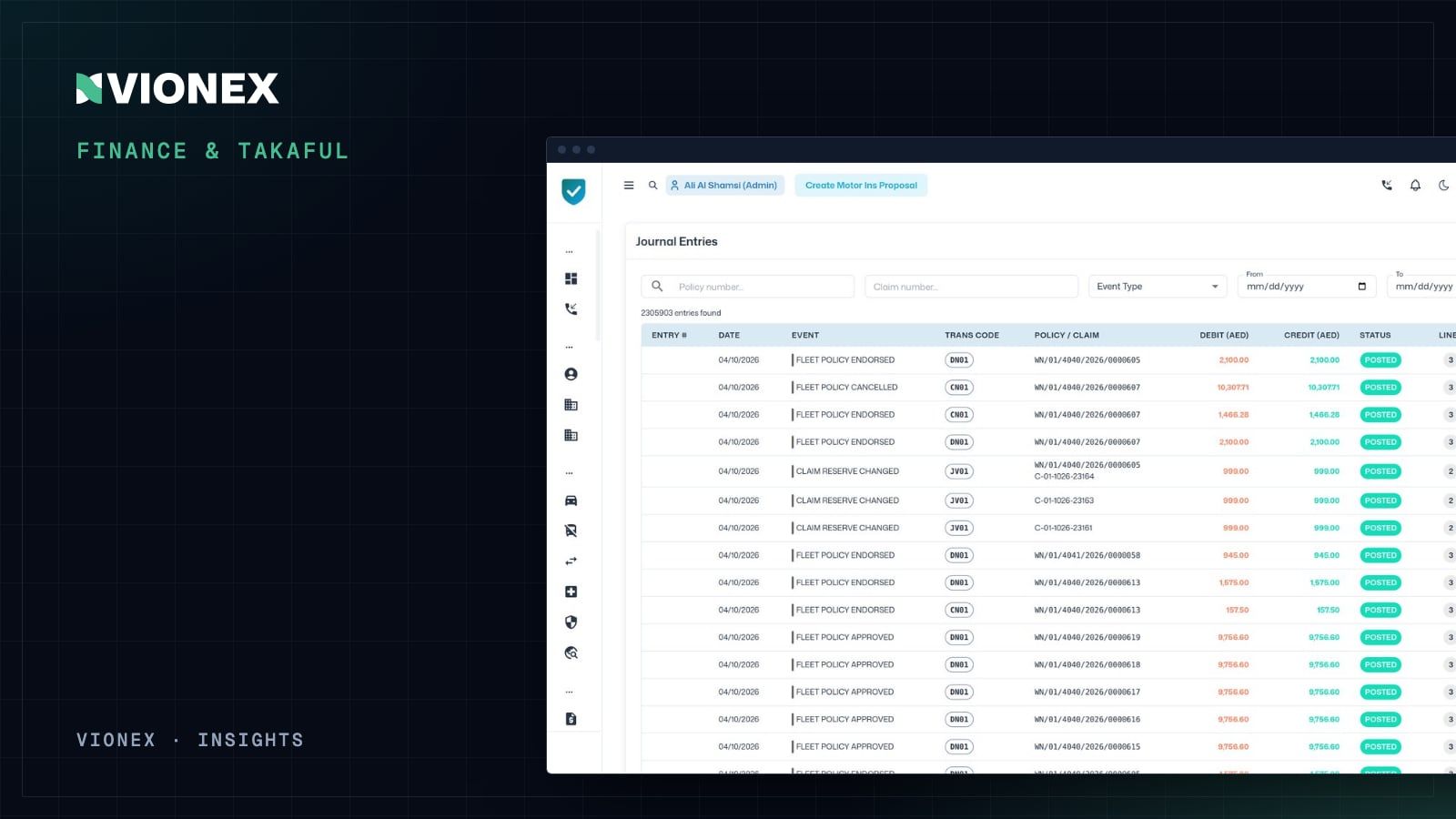
VInsure’s finance module was built with takaful in mind. Each line in its ledger carries a compulsory fund tag: the participants’ risk fund or the shareholders’ fund. The Wakala fee is booked on each contribution as an expense of the participants’ fund and income of the shareholders’ fund; it does not net to zero inside one fund. The rate follows the company’s Sharia-approved policy, and a rate above the cap set in the finance settings is refused. Trial balances come per fund and in total, and the month-end close checks that each fund balances on its own. In the IFRS 17 fund view, Qard Hasan is recorded as a loan, not income, and Mudarib fee and surplus distribution are recorded according to the insurer’s approved policy.
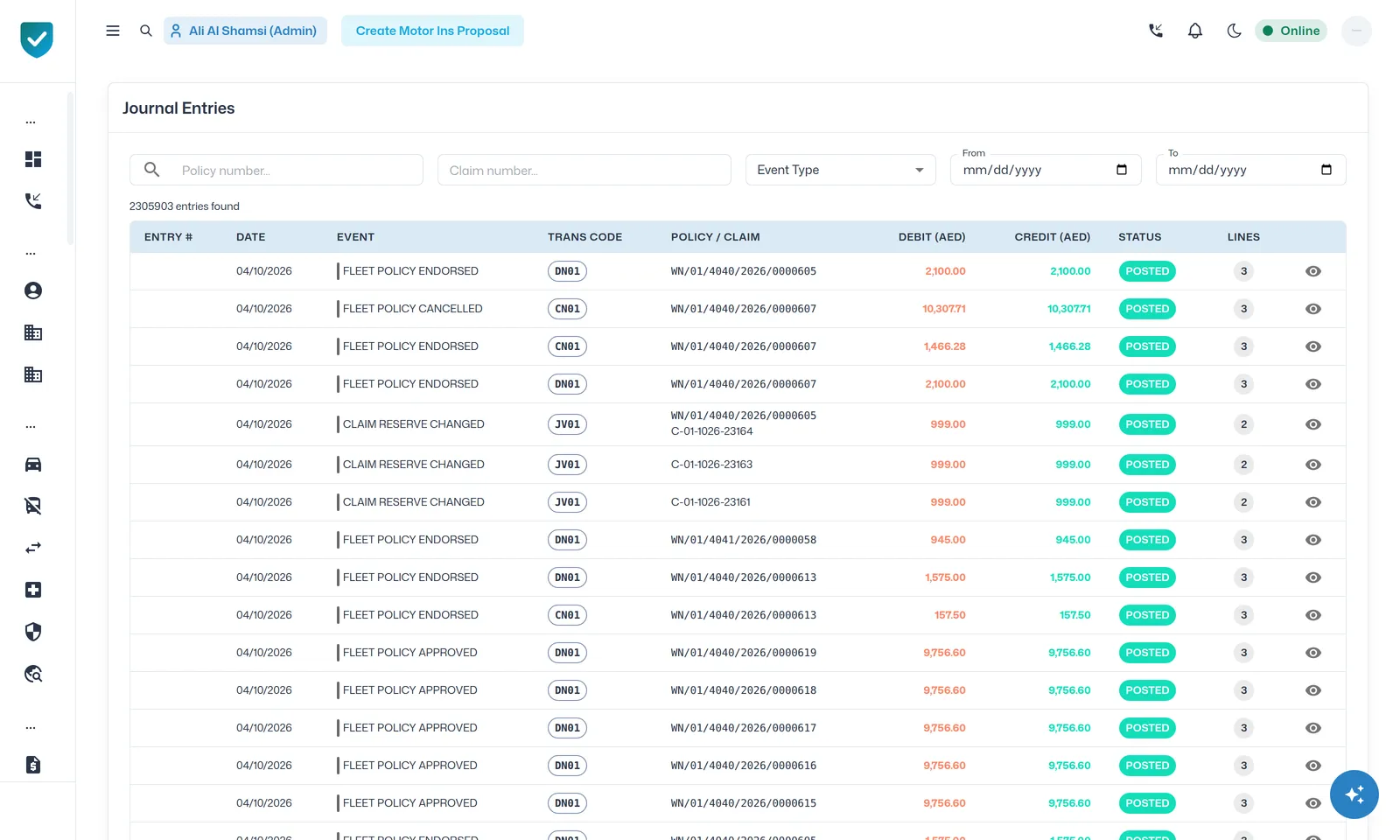 Journal entries written by business events, each balanced and linked to its policy or claim (demo data).
Retakaful treaties, cessions and quarterly statements sit in the reinsurance module and post only to their own accounts. Methaq Takaful, a UAE takaful insurer, runs its daily business on VInsure; you can read how that move was made. If you would like to see the fund view on demo data, book a demo.
Questions people ask
Is takaful insurance the same as Islamic insurance?
Yes, takaful is the usual name for insurance run under Islamic Sharia principles. Participants contribute to a shared fund on the basis of donation (tabarru), the fund pays claims, and the takaful company acts as the fund's manager for a disclosed fee. In the UAE, takaful companies are licensed and supervised by the Central Bank and follow the resolutions of the Higher Sharia Authority.
What is a Wakala fee in takaful?
The Wakala fee is what the fund pays the takaful company for managing it. Under the Central Bank's operational model standard, it is agreed in advance, stated in the participation membership policy and approved each year by the company's internal Sharia supervision committee. It must stay within the maximum set by the Central Bank. In the books it is an expense of the participants' fund and income of the shareholders' fund.
What happens to the surplus in a takaful fund?
Surplus is what remains in the fund at year end after all its obligations are settled. In the UAE it is determined and approved by the company's actuary and distributed under a board- and Sharia-committee-approved surplus policy, only after Central Bank approval. The company may receive up to 10% of the surplus for sound management if the membership policy allows it.
Can a takaful company use conventional reinsurance?
The UAE regulation asks takaful companies to place their cover with retakaful or takaful companies first. If those lack enough capacity, or the risk needs to be spread across more companies, conventional reinsurers may be used under the controls in Central Bank standards. Reinsurance commissions received must go to the fund, not to the shareholders.
Where this lives in our products
- Finance & IFRS 17An insurance general ledger inside the platform. Policies and claims post their own entries, with reinsurance (retakaful) and IFRS 17 built on top.
- Methaq Takaful case studyHow Methaq Takaful Insurance moved from paper files and a legacy core system to digital-first operations on VInsure, with V OCR for documents.
- VInsureVInsure runs policies, claims, finance, IFRS 17, brokers and your customer app on one platform for motor, medical and general insurance in the UAE.
Sources
- Regulation Regarding Takaful Insurance, Central Bank of the UAE (CBUAE Rulebook) (checked )
- Standard Re the Operational Model of Takaful Insurance, Central Bank of the UAE (CBUAE Rulebook) (checked )
- Article (3) – Wakala and Mudaraba’ Fees (Insurance Authority Board Decision No. 26 of 2014, Financial Regulations for Takaful Insurance Companies), Central Bank of the UAE (CBUAE Rulebook) (checked )
- Insurance VAT Guide (VATGIN1), Federal Tax Authority (checked )
This article explains how things work in general. It is not legal, regulatory, tax or actuarial advice: confirm how a rule applies to your company with your own advisers.

About the author
Tony Naief Al Saiegh, Founder & CEO, VIONEX
Tony was born and raised in Abu Dhabi. He started in design and corporate communications, moved into software eleven years ago, and now leads VIONEX's work on insurance technology for UAE and GCC insurers.