Market & regulation
UAE insurance market 2027: what is changing for insurers
The UAE insurance market in Central Bank figures, and the rule changes reshaping insurers' operations in 2026 and 2027: brokers, health, e-invoicing.

Key takeaways
- The UAE insurance market wrote AED 74.8 billion of gross premiums in 2025, up 14.9% on 2024, according to the Central Bank of the UAE.
- Health is now the largest line at AED 36.4 billion, about half of all premiums, in the year mandatory health insurance reached all emirates (1 January 2025).
- Brokers placed 50.9% of premiums in 2025, and under the broker regulation in force since 15 February 2025 they may not collect premiums or issue policies (motor certificates aside, if agreed), so payments and issue sit with the insurer.
- The number of insurers fell from 60 in 2023 to 58 in 2025, while premiums kept rising: a smaller field writing more business.
- Businesses in scope of e-invoicing with revenue of AED 50 million or more must implement it by 1 January 2027, on top of IFRS 17 and the Central Bank's electronic insurance rules.
The UAE insurance market wrote AED 74.8 billion of gross premiums in 2025, up 14.9% on 2024, according to the Central Bank of the UAE (CBUAE). Health is now the largest line, brokers place just over half of all business, and the number of insurers is slowly falling. For insurers, the bigger story is operational: new broker rules, a nationwide health mandate and e-invoicing from 1 January 2027 all change what core systems must do.
Most pages about the UAE insurance market are written for people shopping for a policy, or for buyers of paid market reports. This one is for the people who run insurers: the COO, CFO, heads of underwriting, claims and IT. We use only published figures from the regulator and official sources, say which year each figure covers, and do not forecast numbers we cannot source.
The UAE insurance market in 2025, in figures
The CBUAE’s Annual Statistical Report for the Insurance Sector 2025 is built from the audited returns that insurers file on the Central Bank’s Digital Supervisory Platform. It is the most complete public picture of the market. All figures below are for 2025 unless stated.
| Indicator (2025) | Figure | Change on 2024 |
|---|---|---|
| Gross written premiums (GWP) | AED 74.8 billion | +14.9% |
| of which written on risks inside the UAE | AED 68.5 billion | up from AED 60.0 billion |
| Gross claims paid | AED 46.2 billion | +11.0% |
| Policies written | 17.3 million | +0.1% |
| Technical provisions | AED 96.3 billion | +4.4% |
| Premium retained after reinsurance | 56.0% of GWP | up from 54.9% |
| Commissions paid by insurers | AED 6.3 billion | +20.5% |
| Licensed insurance companies | 58 | 59 in 2024, 60 in 2023 |
Source: CBUAE Annual Statistical Report 2025; company counts for 2023 and 2024 from the CBUAE Annual Report 2024.
Two details matter for operations. First, policy numbers barely moved (+0.1%) while premiums rose by almost 15%. More money is flowing through roughly the same number of policies, so average premium per policy rose. Second, commissions grew faster than premiums (+20.5% against +14.9%), which puts more weight on getting broker commission right.
The same report notes that the UAE ranked 37th in the world for insurance penetration (premiums as a share of GDP) in 2024, citing Swiss Re Institute’s sigma research.
Line mix: health leads, motor is growing fast
The CBUAE groups business into three families. In 2025:
- Health insurance: AED 36.4 billion (+16.3%), about 49% of all premiums.
- Property and liability insurance: AED 30.0 billion (+14.1%). This family includes motor, fire, marine, engineering and other general lines.
- Insurance of persons and fund accumulation (life and savings): AED 8.4 billion (+12.1%).
Inside property and liability, motor and transportation wrote AED 10.1 billion in 2025, up from AED 8.1 billion in 2024. Fire wrote AED 6.9 billion and engineering, construction and energy AED 4.3 billion.
Health policies grew fastest by count: up 26.1% to 2.8 million, in the first year of the nationwide health mandate described below. Property and liability policies fell 4.4% to 14.0 million, even as their premiums rose.
For systems, the message is simple. Health and motor are high-volume, document-heavy lines with regulator connections on both sides (health authorities for medical, traffic authorities for motor). They are where manual work costs the most.
Who sells insurance: brokers, direct, banks and agents
According to the CBUAE, distribution in 2025 split as follows:
| Channel | Share of GWP (2025) | Amount |
|---|---|---|
| Brokers | 50.9% | AED 38.1 billion |
| Direct and other channels | 39.0% | AED 29.2 billion |
| Banks (bancassurance) | 5.8% | AED 4.4 billion |
| Agents | 3.8% | AED 2.8 billion |
Brokers place half the market. Bancassurance grew from 4.3% to 5.8% of premiums. The CBUAE also counted 515 licences for insurance-related professions in 2025 (brokers, agents, consultants, loss adjusters, actuaries and claims administrators), up from 495 in 2024.
The brokers’ regulation changes the plumbing
The CBUAE’s Insurance Brokers’ Regulation, effective from 15 February 2025, changes how money and documents move between broker and insurer. In plain terms:
- Brokers may not collect premiums for primary insurance. Clients pay the insurer directly, and the broker must tell the client so in writing.
- Claim payments and premium refunds go directly from the insurer to the client.
- Brokers may not be authorised to issue or amend policies or endorsements, except motor insurance certificates where both parties agree.
- The insurer must pay the broker’s commission within the time in their agreement, and no later than 10 business days after receiving the premium.
Each of these lands on the insurer’s systems. The insurer needs its own payment collection (links, gateways, bank transfers) for broker-introduced business, a clean record of which broker introduced which policy, and commission that is calculated and released on a clock. Readers should confirm with their compliance team how the regulation applies to their own broker agreements.
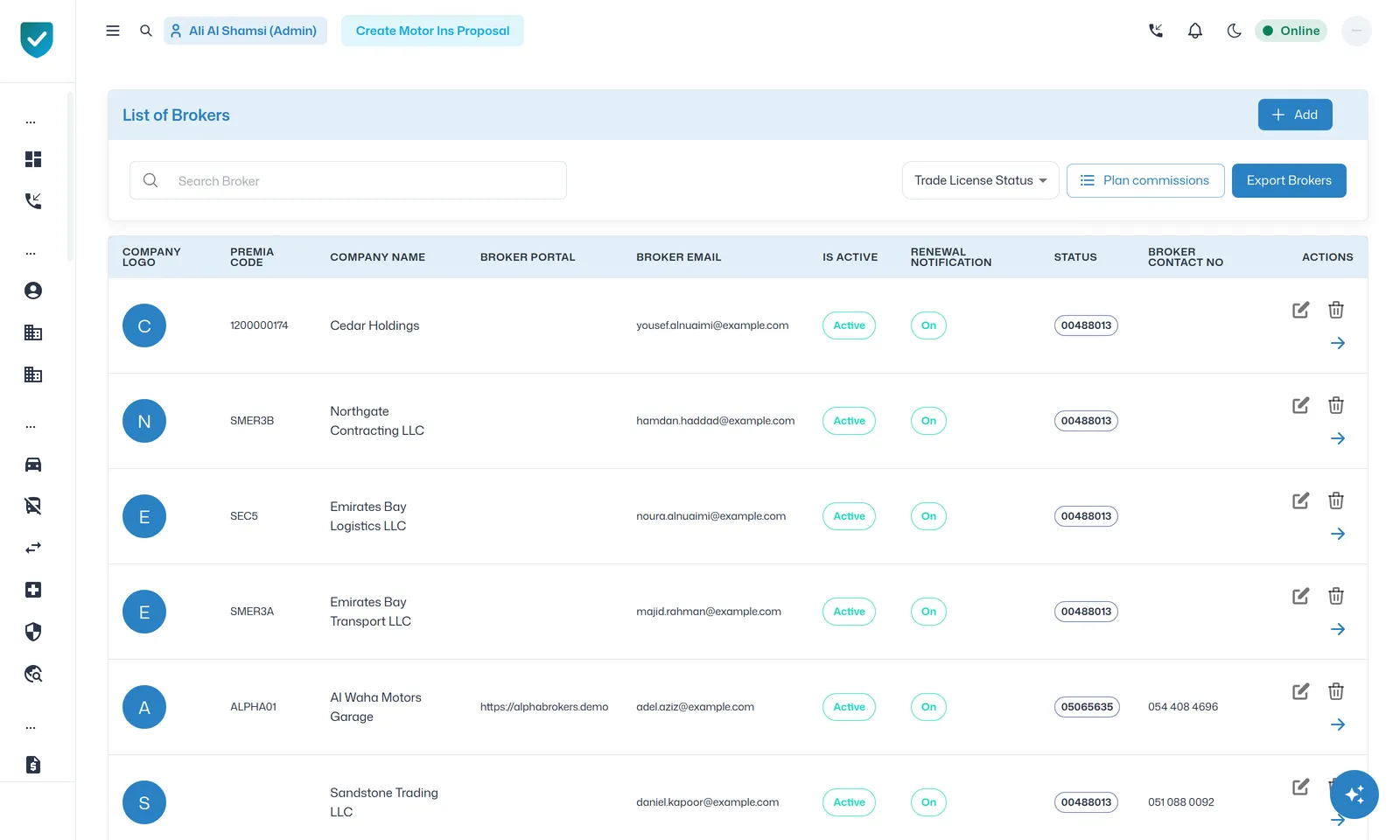 The broker network list, where the insurer sets what each broker can sell and at what commission (demo data).
Consolidation: fewer insurers, more premium
The CBUAE counted 60 licensed insurers in 2023, 59 in 2024 and 58 in 2025. The 2025 field was made up of 22 national conventional insurers, 10 national Takaful insurers and 26 branches of foreign insurers.
Fewer companies writing more premium means larger books per insurer on average. Where the change comes from mergers or portfolio transfers, an insurer can end up running more than one legacy system side by side. That is where data migration, policy history and the general ledger become board-level topics, not IT ones. Our guide What is a core insurance system? explains what a single platform should hold.
Takaful’s share of national insurers
The CBUAE splits national insurers into conventional and Takaful. In 2025, the 10 national Takaful insurers wrote AED 6.3 billion, which is 11.7% of premiums written by national insurers. That share was 11.5% in 2024 and 14.9% in 2020, so Takaful has grown in money but not in share.
Takaful accounts differ from conventional ones: contributions go into a participants’ fund that the operator manages for a fee, and the operator’s own results are kept separate. Systems must keep the funds apart in each entry. Our explainer Takaful insurance explained covers how the model works in practice.
Health: the nationwide mandate since 1 January 2025
Abu Dhabi and Dubai have required health insurance for private-sector employees for years. Since 1 January 2025, following a Cabinet decision, it is required in all emirates for private-sector employees and domestic workers. The Ministry of Human Resources and Emiratisation (MoHRE) explains that employers must buy health insurance as a condition for issuing or renewing a residence permit. A basic package is offered at AED 320 a year. Workers whose valid work permits pre-date 1 January 2025 must be insured when their residence permit is next renewed.
The CBUAE’s 2025 report lists the mandate among the year’s main regulatory developments. For insurers it means many more small group and individual policies, short deadlines tied to visa processing, and more member-level administration: additions, deletions, cards and continuity of cover. Our Shafafiya explainer covers one part of this for Abu Dhabi.
Rules that reach into insurers’ systems
Beyond brokers and health, four rule sets shape what an insurer’s systems must do in 2026 and 2027.
The insurance law and the Central Bank’s oversight
Federal Decree-Law No. 48 of 2023 Regulating Insurance Activities is the current insurance law. The CBUAE regulates insurers under it, having replaced the former Insurance Authority. Two points matter for systems: policies concluded in the UAE must be in Arabic (a translation may be attached, and the Arabic text prevails), and policies may be issued electronically under conditions set by the Central Bank’s Board. Our companion piece Who regulates insurance in the UAE? explains the regulators in more detail.
The electronic insurance regulation
The Electronic Insurance Regulations (Insurance Authority Board Resolution No. 18 of 2020, still in force under the CBUAE) set requirements for insurers’ websites and apps. Among them: customer data is stored inside the UAE; customer identity records from online sales are kept for at least 10 years; electronic policies are issued in PDF and available in the customer’s account; customers are told at least one month before expiry; online claim forms return a reference number; and price comparison sites may only work through licensed brokers.
IFRS 17 and financial reporting
IFRS 17 Insurance Contracts has applied to annual reporting periods beginning on or after 1 January 2023, according to the IFRS Foundation. The CBUAE’s Financial Reporting and External Audit Regulation, effective from 30 April 2024, requires insurers to prepare financial statements under IFRS and the Central Bank’s instructions. IFRS 17 needs policy-level data on premiums, acquisition costs and claims; insurers whose figures are assembled by hand at year end feel this most.
E-invoicing from 1 January 2027
The Ministry of Finance’s Ministerial Decisions No. 243 and No. 244 of 2025 bring in e-invoicing for business-to-business and business-to-government transactions. Ministerial Decision No. 66 of 2026 moved one deadline:
| Business size | Appoint an accredited service provider by | Implement e-invoicing by |
|---|---|---|
| Revenue of AED 50 million or more | 30 October 2026 | 1 January 2027 |
| Revenue below AED 50 million | 31 March 2027 | 1 July 2027 |
Business-to-consumer transactions are outside e-invoicing until the Minister decides otherwise, and financial services that are VAT-exempt or zero-rated are excluded. Which of an insurer’s invoices, credit notes and commission documents fall in scope is a question for its tax team and advisers.
What this means for insurers’ systems
Put together, the market figures and the rules point to the same list. A modern platform should help an insurer:
- Collect premiums itself on broker business, with payment links and gateways, and keep a clear record of the introducing broker.
- Calculate broker commission automatically at issue, adjust it on endorsements and claw it back on cancellation, so it can be paid on time.
- Issue Arabic and English documents, including electronic policies in PDF that customers can open in their own account.
- Handle high-volume health administration: member changes, cards, continuity checks and regulator files.
- Keep data in the UAE, with records and backups kept for the required periods.
- Track regulator complaints with a deadline and a register.
- Build IFRS 17 and VAT from the same ledger that policies and claims write to, and produce structured invoices ready for an accredited e-invoicing provider.
- Keep Takaful funds separate in each entry, if you are a Takaful operator.
How VInsure handles this
VInsure is VIONEX’s insurance core system, built in the UAE around UAE rules. Brokers work in their own walled-off workspace; the insurer sets each broker’s products, plans, limits and commission, and commission is recorded automatically when a policy is issued, adjusted on endorsements and clawed back on cancellation with a debit note (Distribution). Customers pay by link or by card, and the insurer’s own app and website run on the same core, in English and Arabic (App & Website).
On the finance side, each step writes its own accounting entry, Takaful-aware and with UAE VAT. Invoices are generated and validated in the required structure, ready to hand to the accredited service provider the insurer appoints, and IFRS 17 reporting is built on the insurer’s own ledger, with every figure traceable to its policy (Finance, Reinsurance & IFRS 17). Methaq Takaful runs its daily business on VInsure; read the case study or book a demo.
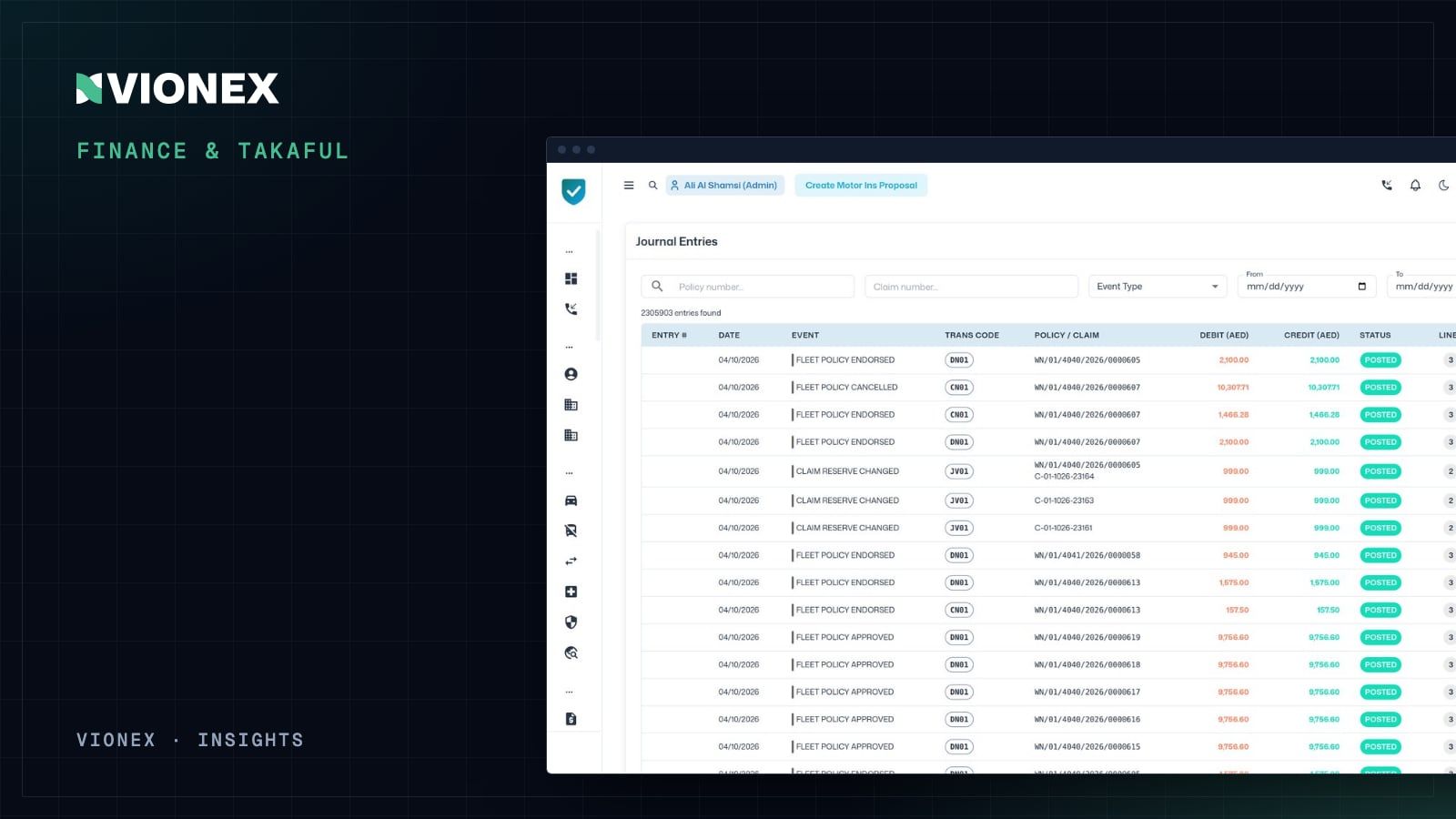
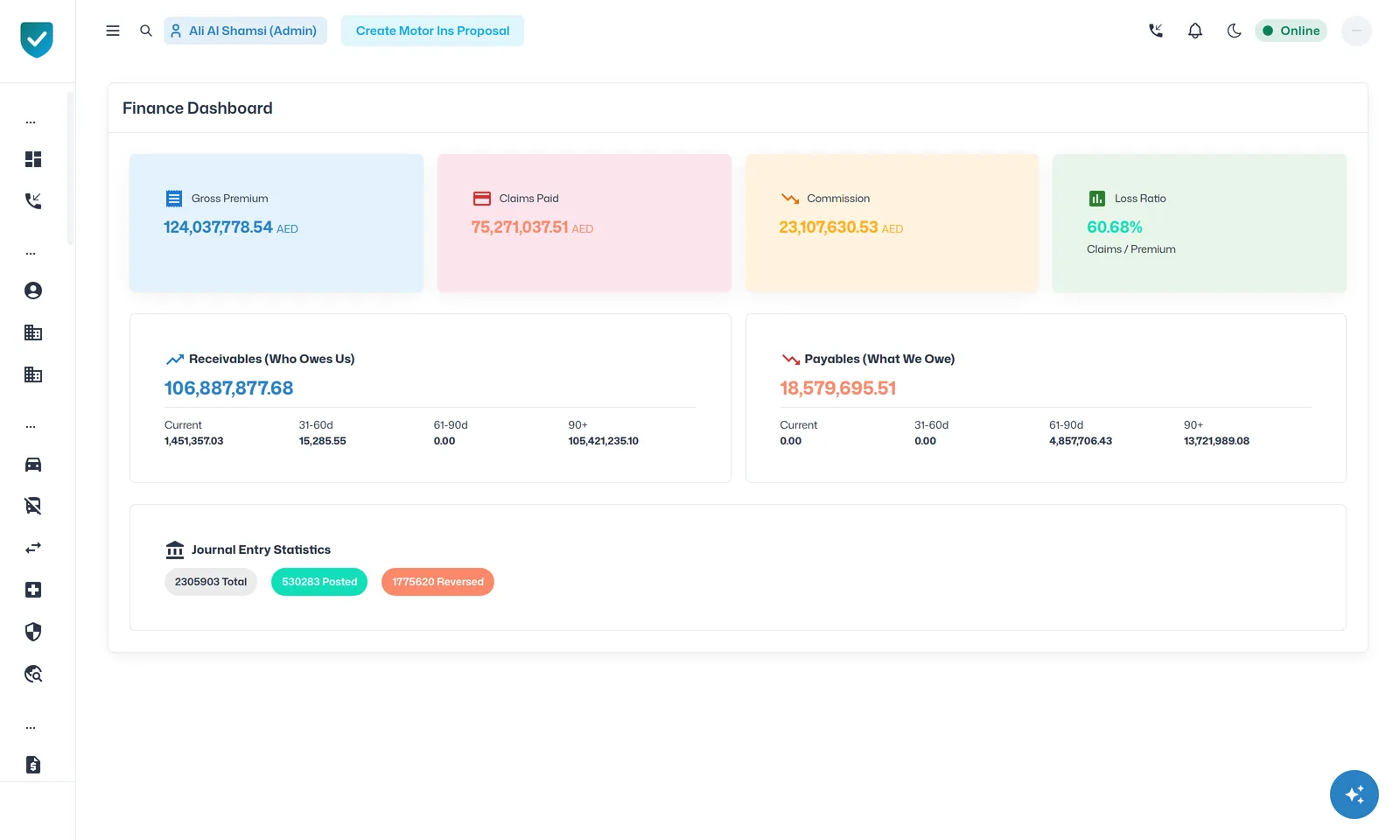 The accounting dashboard, where entries written by policies and claims are reviewed and closed (demo data).
This article describes published figures and rules for general information. It is not legal, regulatory or tax advice; confirm how any rule applies to your company with your compliance, legal or tax team.
Questions people ask
How big is the UAE insurance market?
The Central Bank of the UAE reports AED 74.8 billion of gross written premiums for 2025, from 58 licensed insurers. About AED 68.5 billion of that was written on risks inside the UAE and AED 6.3 billion on business from outside. Gross claims paid were AED 46.2 billion, and 17.3 million policies were written.
How many insurance companies are there in the UAE?
At the end of 2025 there were 58 licensed insurance companies: 22 national conventional insurers, 10 national Takaful insurers and 26 branches of foreign insurers. The Central Bank counted 60 in 2023 and 59 in 2024. A further 515 licences were held by insurance-related professions such as brokers, agents, loss adjusters and claims administrators.
Which insurance line is largest in the UAE?
Health insurance. In 2025 health premiums reached AED 36.4 billion, about 49% of the market. Property and liability lines, which include motor, wrote AED 30.0 billion, and life and savings business (the Central Bank's 'insurance of persons and fund accumulation') wrote AED 8.4 billion.
Who regulates the UAE insurance market?
The Central Bank of the UAE (CBUAE). It took over the former Insurance Authority's role from 2 January 2021 and supervises insurers under Federal Decree-Law No. 48 of 2023. Health insurance also has emirate-level regulators, such as the Department of Health in Abu Dhabi and the Dubai Health Authority.
Where this lives in our products
- VInsureVInsure runs policies, claims, finance, IFRS 17, brokers and your customer app on one platform for motor, medical and general insurance in the UAE.
- DistributionOnboard brokers, set what each can sell and at what commission, and give them their own portal. A broker API connects aggregators and comparison sites.
- Finance & IFRS 17An insurance general ledger inside the platform. Policies and claims post their own entries, with reinsurance (retakaful) and IFRS 17 built on top.
- App & WebsiteA customer app for iOS and Android and a bilingual website under your brand. Customers buy cover, renew and track claims in Arabic or English.
Sources
- Annual Statistical Report for the Insurance Sector of the U.A.E. 2025, Central Bank of the UAE (checked )
- Central Bank of the UAE Annual Report 2024, Central Bank of the UAE (checked )
- Insurance Brokers’ Regulation (C 1/2024), Central Bank of the UAE (CBUAE Rulebook) (checked )
- Insurance Authority Board of Directors' Resolution No. (18) of 2020 Concerning the Electronic Insurance Regulations, Central Bank of the UAE (CBUAE Rulebook) (checked )
- Federal Decree-Law No. (48) of 2023 Regulating Insurance Activities (Central Bank legal publication), Central Bank of the UAE (checked )
- The Basic Health Insurance Scheme, Ministry of Human Resources and Emiratisation (checked )
- Ministerial Decision No. 244 of 2025 on the Implementation of the Electronic Invoicing System, Ministry of Finance, UAE (checked )
- Ministerial Decision No. (66) of 2026 amending Ministerial Decision No. 244 of 2025, Ministry of Finance, UAE (checked )
- Ministerial Decision No. 243 of 2025 on the Electronic Invoicing System, Ministry of Finance, UAE (checked )
- IFRS 17 Insurance Contracts, IFRS Foundation (checked )
- Financial Reporting and External Audit Regulation (C 5/2023), Central Bank of the UAE (CBUAE Rulebook) (checked )
This article explains how things work in general. It is not legal, regulatory, tax or actuarial advice: confirm how a rule applies to your company with your own advisers.

About the author
Tony Naief Al Saiegh, Founder & CEO, VIONEX
Tony was born and raised in Abu Dhabi. He started in design and corporate communications, moved into software eleven years ago, and now leads VIONEX's work on insurance technology for UAE and GCC insurers.