Market & regulation
Insurance Authority UAE: who regulates insurance in the UAE today?
The UAE Insurance Authority merged into the Central Bank in 2021. Who regulates insurers today, which law applies, and who oversees health and motor.

Key takeaways
- The UAE Insurance Authority no longer exists as a separate body: the Central Bank of the UAE replaced it in all its powers from 2 January 2021, under Federal Decree-Law No. 25 of 2020.
- The current insurance law is Federal Decree-Law No. 48 of 2023 Regulating Insurance Activities, which repealed Federal Law No. 6 of 2007.
- Many rules still carry the Insurance Authority's name, such as the Electronic Insurance Regulations of 2020, and remain in force until the Central Bank replaces them.
- Consumer complaints against insurers go first to the insurer, then to Sanadak, the independent ombudsman unit set up by the Central Bank in 2023.
- Health insurance also has emirate regulators (the Department of Health in Abu Dhabi, the Dubai Health Authority), and motor cover is checked by traffic authorities at vehicle registration.
The UAE Insurance Authority no longer exists as a separate regulator. Under Federal Decree-Law No. 25 of 2020, the Central Bank of the UAE (CBUAE) replaced it in all its powers from 2 January 2021, and today insurers are licensed and supervised by the Central Bank under Federal Decree-Law No. 48 of 2023 Regulating Insurance Activities. Health insurance also answers to emirate health regulators, and consumer complaints go to Sanadak, the Central Bank’s independent ombudsman unit.
People still search for the “insurance authority UAE”, and many rules on the books still carry its name. This guide explains what happened to it, which law and which bodies apply now, and what that means for an insurer’s day-to-day systems. It describes the rules; it does not tell you how they apply to your company.
What happened to the Insurance Authority
The short history, in four steps:
- 2007. Federal Law No. 6 of 2007 set up the Insurance Authority and regulated insurance business. The Central Bank’s legal publication records it as issued on 15 February 2007.
- 2020 to 2021. Federal Decree-Law No. 25 of 2020 provided that “the Central Bank and its Board of Directors replace the Insurance Authority” in all its competencies, rights, obligations and assets, with the Governor taking over the Director General’s powers. It came into force on 2 January 2021.
- 2023. Federal Decree-Law No. 48 of 2023 Regulating Insurance Activities was issued on 2 October 2023 and published in the Official Gazette on 31 October 2023. It came into force 30 days after publication and repealed Federal Law No. 6 of 2007.
- Today. The CBUAE regulates and supervises insurers and insurance-related professions such as brokers, agents, loss adjusters, actuaries and health claims administrators.
One detail confuses many readers. Both the 2020 decree-law and the 2023 law say that regulations, resolutions and circulars issued under the old law stay in force until the Central Bank replaces them, as long as they do not conflict with the new law. That is why the CBUAE Rulebook still lists rules titled “Insurance Authority Board of Directors’ Resolution”, such as the Electronic Insurance Regulations of 2020.
The insurance law today: Federal Decree-Law No. 48 of 2023
The 2023 law sets the framework; the Central Bank’s Board issues the detailed rules. Among the points that matter most to operations:
- Scope. It applies to insurance companies and insurance-related professions, and to holding companies above set thresholds.
- The Board’s powers. The Board sets solvency and minimum guarantee fund controls, how technical provisions are calculated, reinsurance standards, investment rules, Takaful regulation and financial reporting.
- Policy language. Policies concluded in the UAE must be in Arabic. A translation may be attached, and if the two differ the Arabic text prevails. Clauses that exempt the insurer from liability must be in bold, in a different colour, and endorsed by the insured.
- Electronic policies. Policies may be issued electronically, on terms set by the Board.
- Motor. Insurers must issue a policy for any motor vehicle licensed in the UAE when asked, at rates set by the Board.
- Takaful. Takaful insurers follow the same law, as far as it fits their nature, and must not breach Sharia principles.
- Records. Electronic copies of books, records and documents carry the same weight as the originals, under the relevant legislation.
What each body oversees
| Body | What it oversees for insurers | Key source |
|---|---|---|
| Central Bank of the UAE (CBUAE) | Licensing, supervision and enforcement for insurers and insurance-related professions; solvency, provisions, reporting, conduct, brokers, electronic insurance | Federal Decree-Law No. 48 of 2023; CBUAE Rulebook |
| Sanadak (CBUAE ombudsman unit) | Independent handling of consumer complaints against insurers and banks; insurance disputes | CBUAE Ombudsman Unit Regulation, effective 15 March 2023 |
| Department of Health – Abu Dhabi (DoH) | Abu Dhabi health insurance scheme: licensing insurers, TPAs and brokers for health, the standard tariff, health insurance disputes and complaints | Abu Dhabi Law No. 23 of 2005; DoH Healthcare Insurers Manual |
| Dubai Health Authority (DHA) | Dubai health insurance: authorising insurers, claims management companies and brokers for health insurance; benefits and cost monitoring | Dubai Law No. 11 of 2013 |
| Federal health scheme (other emirates) | Mandatory health cover for private-sector employees and domestic workers in all emirates since 1 January 2025 | u.ae; MoHRE |
| Traffic authorities (e.g. RTA in Dubai) | Check for valid motor insurance at vehicle registration and renewal | RTA service pages |
The tax side is separate: VAT and e-invoicing sit with the Ministry of Finance and the Federal Tax Authority, which we cover in our UAE insurance market 2027 overview.
Central Bank rules that reach insurers’ systems
The CBUAE Rulebook holds dozens of insurance rules. Four have the most direct effect on core systems, websites and apps.
Electronic Insurance Regulations (Resolution No. 18 of 2020)
In force since 28 April 2020 and still applied by the Central Bank, these rules cover selling insurance online. They require, among other things:
- data obtained through the website stored inside the UAE, with backups and a recovery plan;
- the website or app available around the clock, with maintenance of no more than one working day;
- customer identity records from online sales kept for at least 10 years;
- an electronic account for each customer, protected by a board-approved login policy that uses two factors;
- electronic policies issued as complete PDF documents, viewable and downloadable from the customer’s account;
- a post-sale section where customers can check policy status, dates, premiums and payments;
- notice to the customer at least one month before the policy expires;
- online claim forms that return a claim reference number, and clear complaint information on the website.
Insurance Brokers’ Regulation (effective 15 February 2025)
Brokers may not collect premiums, claim payments or refunds on primary insurance, and may not be authorised to issue or amend policies or endorsements (except motor insurance certificates, if both sides agree). Insurers must pay broker commission no later than 10 business days after receiving the premium. The result: collection, issue and commission timing sit inside the insurer’s own systems.
Financial Reporting and External Audit Regulation (effective 30 April 2024)
Insurers must keep proper records, prepare financial statements under International Financial Reporting Standards (IFRS) and the Central Bank’s instructions, and publish audited annual accounts. For insurance contracts that means IFRS 17.
The ombudsman regulation
Insurers must tell consumers in writing of their right to take a complaint to Sanadak, and give them Sanadak’s contact details. More on this below.
Complaints: Sanadak and the Insurance Dispute Resolution Committee
Sanadak was set up by the Central Bank as an independent unit with its own legal personality, under the Ombudsman Unit Regulation effective from 15 March 2023. According to the UAE government portal, it resolves consumer complaints against licensed financial institutions and insurance companies free of charge.
The path for an insurance complaint is:
- The customer complains formally to the insurer first.
- If it is not resolved, the customer files with Sanadak online.
- Sanadak reviews it and issues a determination.
- Either party may refer an insurance determination to the Insurance Dispute Resolution Committee, whose powers the Central Bank delegated to Sanadak, within 30 complete business days of the determination.
Sanadak may reject a complaint that was not raised with the insurer first, is already in court, or has already been settled. For an insurer, that means a complaints process with clear dates and records is not just good service; it is the evidence Sanadak will ask for.
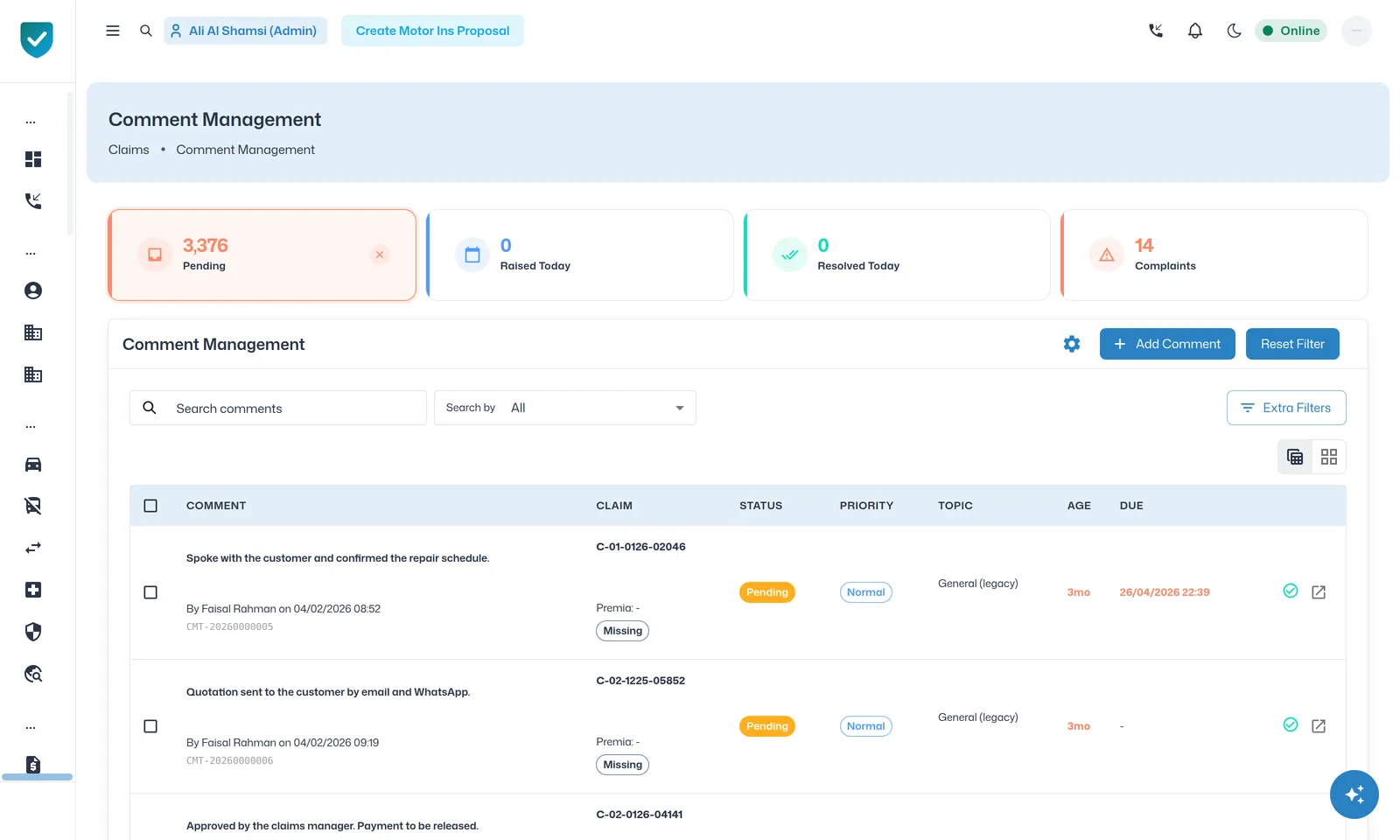 The claims comment queue, where customer concerns become tickets with a status, priority, topic and due date, and complaints are counted separately (demo data).
Health and motor: the other regulators insurers deal with
Health. Abu Dhabi’s health insurance scheme runs under Law No. 23 of 2005. The Department of Health licenses and inspects insurers, TPAs (third-party administrators) and brokers in the scheme, sets the standard tariff, and handles disputes and complaints within it. In Dubai, Law No. 11 of 2013 gives the Dubai Health Authority the power to authorise insurers, claims management companies and brokers for health insurance, and to monitor benefits and costs. Since 1 January 2025, employers in all emirates must provide health cover for private-sector employees and domestic workers before a residence permit is issued or renewed. Insurers selling medical cover therefore work to the CBUAE and, in Abu Dhabi and Dubai, to the emirate’s health regulator as well. Our Shafafiya explainer covers one of the Abu Dhabi data services.
Motor. Traffic authorities check that a vehicle has valid insurance before registration or renewal. Dubai’s RTA, for example, states that for online renewals the insurance details are updated on the traffic system through the insurance company. Insurers need a reliable link from policy issue to the traffic record.
Takaful. Takaful operators follow the same law and Central Bank rules, plus Sharia governance. See Takaful insurance explained.
Not to be confused with Saudi Arabia’s Insurance Authority
Saudi Arabia has its own Insurance Authority (ia.gov.sa), which regulates and supervises insurance in the Kingdom. It has no role in the UAE. Because both countries have used the same name, search results for “insurance authority” often mix them up. A UAE page dated after January 2021 should refer to the Central Bank, not an Insurance Authority, as the regulator.
What to look for in your systems
Regulation is a moving target, so the question for a core system is how much of it is built in as settings and records, rather than handled in spreadsheets. Look for:
- Regulator complaints with deadlines, restricted access and a register you can show on request.
- Arabic and English documents throughout, with the Arabic version as the policy of record.
- Customer data kept in the UAE, with retention and backups set to the required periods.
- A customer account with electronic policies, status, payments and renewal reminders.
- Insurer-side collection and issue for broker business, with commission calculated on issue.
- Health and motor regulator connections: health authority checks and files, and registration with the traffic authority.
How VInsure handles this
In VInsure, a ticket can be flagged as a Central Bank complaint. It then becomes critical, gets an automatic reference number and a 3-working-day deadline that cannot be edited while the flag is on, and only the complaints department and the assigned handler can work it. A daily overdue digest and a Complaints Register keep management informed (Motor Claims, complaints). AI comment triage leaves regulator complaints to a person.
The platform is bilingual in English and Arabic across the portal, documents, the app and the website. Customer data is kept in-country, and records are designed around the UAE record-keeping rules, with the retention and backup set-up agreed during implementation (Trust & Platform). Motor cover is registered with the traffic authority, and the medical module carries the health regulator tools: DHA and DoH approval numbers, the Shafafiya continuity check for Abu Dhabi and claim files in the Central Bank’s format (Medical). To see it on a live system, book a demo.
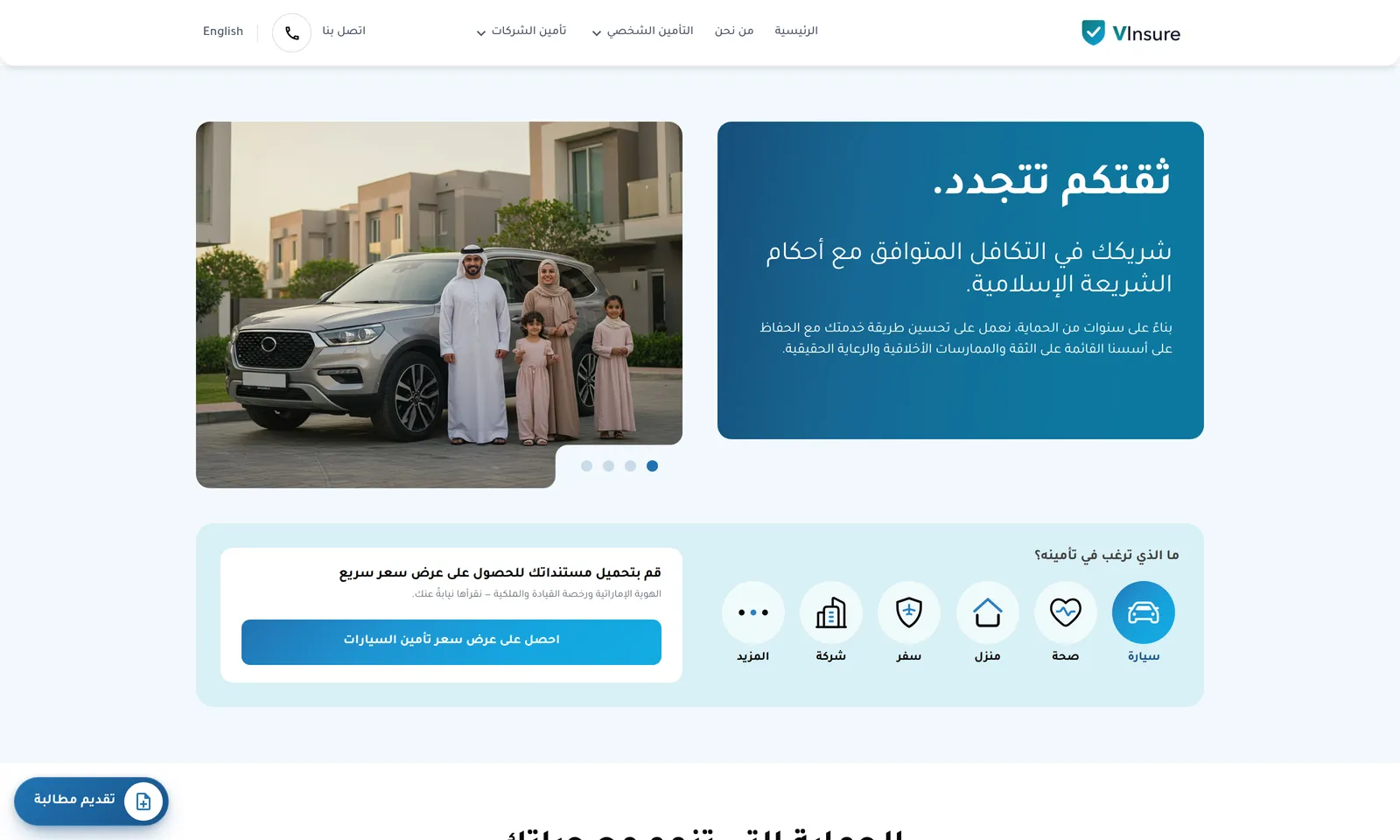 An insurer’s public website in Arabic, running on the same core as the staff portal (demo data).
This guide describes laws and regulations for general information only. It is not legal or regulatory advice; confirm how any rule applies to your company with your compliance or legal team.
Questions people ask
Does the UAE Insurance Authority still exist?
No. Federal Decree-Law No. 25 of 2020 provided that the Central Bank of the UAE and its Board replace the Insurance Authority in all its competencies, rights and obligations. The change took effect on 2 January 2021. Rules issued by the old Authority still apply until the Central Bank issues replacements, which is why some current rules carry its name.
Is the UAE Insurance Authority the same as the Saudi Insurance Authority?
No. The Saudi Insurance Authority (ia.gov.sa) is the insurance regulator of Saudi Arabia, a separate body in a separate country. In the UAE, insurance is regulated by the Central Bank of the UAE. Searches for 'insurance authority' often mix the two, so check which country a page refers to.
Where can I complain about an insurance company in the UAE?
First, raise a formal complaint with the insurance company itself. If it is not resolved, you can take it to Sanadak, the independent financial and insurance ombudsman unit established by the Central Bank. Filing is free for consumers and small and medium businesses, through Sanadak's online platform. Insurers must tell customers in writing that they can go to Sanadak.
Which law regulates insurance companies in the UAE?
Federal Decree-Law No. 48 of 2023 Regulating Insurance Activities. It was issued on 2 October 2023, published in the Official Gazette on 31 October 2023, and came into force 30 days after publication. It replaced Federal Law No. 6 of 2007 and gives the Central Bank's Board the power to issue the detailed regulations.
Where this lives in our products
- Trust & PlatformSeparate environments, controlled releases, round-the-clock monitoring, role-based access and customer data kept in-country. How VInsure is run.
- Motor ClaimsRun motor claims from first notice to final payout in one system, including garage networks, repair approvals, total loss and salvage recovery.
- MedicalSell, issue and service individual, family and SME group medical cover, with hospital networks as live data and the regulator's checks built into the sale.
- App & WebsiteA customer app for iOS and Android and a bilingual website under your brand. Customers buy cover, renew and track claims in Arabic or English.
Sources
- Decretal Federal Law No. (25) of 2020 Regarding the amendment of some provisions of the Decretal Federal Law No. (14) of 2018, Central Bank of the UAE (CBUAE Rulebook) (checked )
- Federal Decree-Law No. (48) of 2023 Regulating Insurance Activities (Central Bank legal publication), Central Bank of the UAE (checked )
- Central Bank of the UAE Annual Report 2024, Central Bank of the UAE (checked )
- Insurance Authority Board of Directors' Resolution No. (18) of 2020 Concerning the Electronic Insurance Regulations, Central Bank of the UAE (CBUAE Rulebook) (checked )
- Insurance Brokers’ Regulation (C 1/2024), Central Bank of the UAE (CBUAE Rulebook) (checked )
- Financial Reporting and External Audit Regulation (C 5/2023), Central Bank of the UAE (CBUAE Rulebook) (checked )
- Establishment of an Ombudsman Unit for The United Arab Emirates Regulation, Central Bank of the UAE (CBUAE Rulebook) (checked )
- Raising complaints against financial institutions and insurance companies, The Official Platform of the UAE Government (u.ae) (checked )
- Healthcare Insurers Manual, Department of Health – Abu Dhabi (checked )
- Law No. (11) of 2013 Concerning Health Insurance in the Emirate of Dubai, Dubai Health Authority (ISAHD) (checked )
- Getting a health insurance, The Official Platform of the UAE Government (u.ae) (checked )
- Renew Vehicle Ownership, Roads and Transport Authority, Dubai (checked )
- Frequently asked questions, Insurance Authority, Kingdom of Saudi Arabia (checked )
This article explains how things work in general. It is not legal, regulatory, tax or actuarial advice: confirm how a rule applies to your company with your own advisers.

About the author
Tony Naief Al Saiegh, Founder & CEO, VIONEX
Tony was born and raised in Abu Dhabi. He started in design and corporate communications, moved into software eleven years ago, and now leads VIONEX's work on insurance technology for UAE and GCC insurers.