AI & documents
Reading Emirates ID and Mulkiya automatically: insurance OCR explained
How insurance OCR reads Emirates ID, driving licence, Mulkiya and trade licence in Arabic and English, what it checks, and what to look for.

Key takeaways
- A UAE motor sale usually needs an Emirates ID, a driving licence and a vehicle registration (Mulkiya) or clearance certificate; companies add a trade licence.
- Insurance OCR does more than read text: it checks image quality, works out which document it is looking at, reads the fields in Arabic and English, then validates them.
- Good systems leave unclear fields empty and send doubtful or possibly altered documents to a person, instead of guessing.
- Ask any vendor how it handles the wrong card, the wrong side, glare and tamper signals, not only how accurate it is on clean samples.
- These documents hold personal data, so check where it is processed and stored with your compliance team.
Insurance OCR (optical character recognition) reads the documents a customer hands over, such as the Emirates ID, driving licence and vehicle registration card (Mulkiya), and fills the policy form from them, so people review data instead of typing it. In the UAE that means reading Arabic and English, telling one card from another, and checking each value before it reaches a quotation. This article explains which documents are involved, how intelligent document processing for insurance works step by step, and what to look for before you choose a system.
The documents in a UAE motor or medical sale
Most UAE insurance sales start with the same small stack of cards. The exact set depends on the product and the customer.
| Document | When it appears | What the insurer needs from it |
|---|---|---|
| Emirates ID (front and back) | Most individual sales, motor and medical | Name in Arabic and English, ID number, date of birth, nationality, card expiry |
| Driving licence | Motor | Licence number, issue and expiry dates, licence class |
| Vehicle registration card (Mulkiya), front and back | Motor renewals and changes of insurer | Chassis number, engine number, model year, vehicle type, colour, passengers |
| Vehicle clearance certificate (VCC) | When a car is registered, for example a new car | Make, model year, chassis and engine numbers, origin, owner |
| Trade licence | Company customers: fleets, group medical, commercial lines | Licence number, trade name, legal type, expiry, activities, emirate |
The Emirates ID is the government-issued identity card for UAE citizens and residents, and the UAE Government portal says it is mandatory for all of them to apply for one. Its identity number has 15 digits.
Motor insurance sits inside the vehicle registration process itself. According to the UAE Government’s page on registering vehicles, getting vehicle insurance from an authorised insurer is one of the steps before registration, and the documents for registering a car include a vehicle document such as the VCC, the original Emirates ID and an electronic vehicle insurance document. Companies also provide a copy of the trade licence. So when a customer buys motor cover, these are the papers already in their hand.
Why typing them in is slow and error-prone
Re-typing documents looks cheap until you count what it costs.
- Long numbers. A chassis number is usually 17 characters. An Emirates ID number is 15 digits. One swapped character can mean the wrong car on the policy, or a mismatch at the traffic authority.
- Two languages. Names are written in Arabic and English, and the English spelling of an Arabic name can vary from one document to the next. Staff who type quickly in one script often slow down in the other.
- Two sides. The Emirates ID and the Mulkiya carry important fields on the back. A front-only photo is a common reason for chasing the customer later.
- Many hands. The same documents are typed by brokers, agents, call-centre staff and branch teams. Each one adds a chance of a slip, and slips at the point of sale tend to surface later, at claim time or in an audit.
- The customer waits. A quotation that needs someone to type four documents is a quotation the customer may not wait for, especially on a phone.
The real cost of a typing error is rarely the minute it took. It is the endorsement to fix the chassis number, the claim that stalls because the model year on the policy does not match the car, or the renewal that goes to the wrong person.
How intelligent document processing works, step by step
Insurance OCR, including Emirates ID OCR, is more than reading characters. A useful system wraps the reading in checks. Here is the usual sequence in plain steps.
- Capture. The customer, broker or staff member takes a photo or uploads a file. Phone photos and multi-page PDFs should both work.
- Quality check. The system looks at sharpness, contrast, glare and resolution. It corrects rotation and can enhance a weak image. If the image is too poor, it asks for a retake straight away, while the customer is still holding the card.
- Find and classify the document. It finds the edges of each card, even when several cards are in one photo, and works out what each one is: Emirates ID front, Emirates ID back, Mulkiya, licence, VCC, trade licence. This step matters more than it sounds. A wrong card in the wrong slot should be refused, not read as if it were right.
- Extract the fields. It reads the values in Arabic and English and places them into fixed fields. Good output uses predefined lists where it can (for example vehicle type or emirate) rather than open free text.
- Validate. It checks that the values make sense: dates are real dates, an expiry is in the future, a number has the right length and format. Inside an insurance system, the values can then be checked against the quotation and the underwriting rules.
- Send doubtful cases to a person. Fields that could not be read clearly should come back empty, not guessed. Documents with low confidence or visual signs of tampering go to manual review. The software flags; a person decides.
The last step is the one that separates a demo from a production system. A reader that guesses will look accurate on clean samples and create quiet errors in real use.
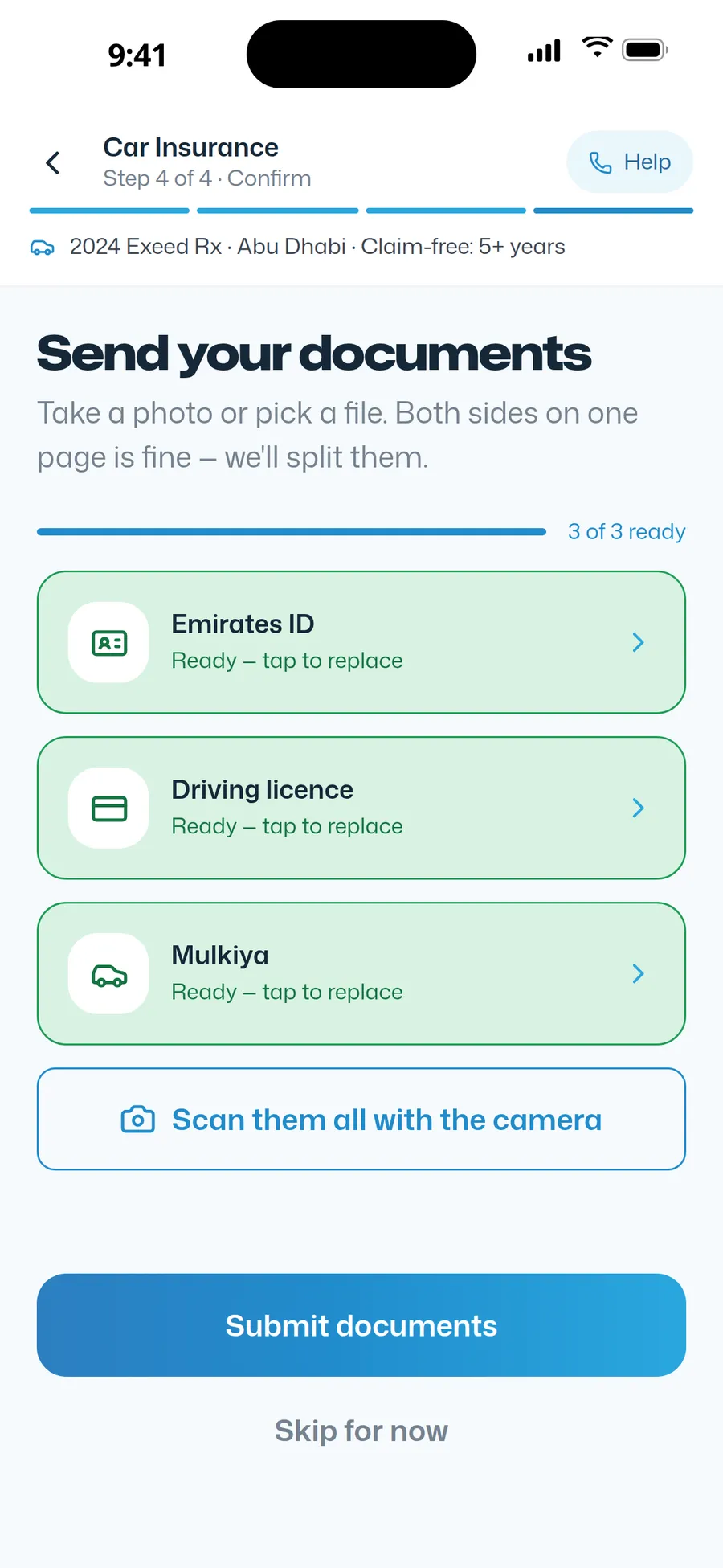 A customer sends the three motor documents from the insurer’s app before the policy is issued (demo data).
What document AI does well, and where people stay in charge
Document AI is very good at the repetitive part: finding the card, reading the fields and putting them in the right boxes in both languages. It removes much of the typing, and the typing errors that come with it.
It should not make the final call on whether a document is genuine. A visual tamper signal is a reason for a person to look, not a verdict. The same goes for a name that reads differently on two documents, or a model year that does not match the price band. These are underwriting and compliance questions, and they belong with your teams.
This also matches the direction of the regulator. The Central Bank of the UAE (CBUAE) guidance note on the responsible use of AI and machine learning, issued on 11 February 2026, applies to licensed financial institutions including insurance providers. It describes meaningful human oversight, with the level of human involvement matched to the risk to the consumer. Confirm with your compliance team how the guidance applies to your own processes.
Privacy: what to ask about the data
Identity cards, licences and registration cards are personal data. In the UAE, the federal law is Federal Decree-Law No. 45 of 2021 on the Protection of Personal Data. The UAE Government portal summarises it: it covers processing of personal data inside or outside the country, it generally requires the owner’s consent except in specified cases, it gives people the right to ask for corrections, and it sets requirements for transferring data across borders. It came into force on 2 January 2022. Health data and some other categories may fall under their own laws, so medical lines need extra care.
The CBUAE guidance note also expects personal data used in AI to be handled in line with the rules on data being retained in the country.
Practical questions to put to any vendor:
- Where are the images processed, and where are they stored?
- How long are the images kept after the fields are read?
- Who can see them, and is access logged?
- Is the connection encrypted, and how are the access keys protected?
Your compliance or legal team should confirm how the law applies to your own processing. This article describes the rules; it is not legal advice.
What to look for in an insurance OCR system
Accuracy on a clean sample is the number most vendors show. These questions tell you more.
- Coverage of UAE documents. Does it read the Emirates ID, driving licence, Mulkiya, VCC and trade licences from all seven emirates, front and back?
- Arabic and English output. Does it return both scripts as separate fields, not a transliteration?
- Wrong card, wrong side. Show it a licence in the ID slot. Does it refuse, and does it explain why?
- Bad photos. Try glare, a tilted card, two cards in one photo. Does it fix what it can and ask for a retake when it can’t?
- Empty, not guessed. When a field is unreadable, does it come back empty?
- Tamper signals and review. Does it flag possible alterations for a person, with a clear review queue?
- Integration. Is there a documented API with keys, rate limits and request tracing, so it can plug into your existing forms, broker portal and app?
- Speed in the real journey. Measure the time from photo to filled form on a phone, not on a laptop.
Test with your own documents, including the awkward ones, and compare the output with what your best staff would type.
How V OCR handles it
V OCR is the VIONEX document-reading product, trained for UAE insurance operations. It reads Emirates IDs, driving licences, Mulkiya, vehicle clearance certificates and trade licences (all seven emirates), front and back, and returns structured data in Arabic and English. Its published figures are 99%+ accuracy, production-tested on real insurance documents, and processing in under 4 seconds. It checks image quality, finds several cards in one photo, refuses a wrong card or wrong side, leaves unclear fields empty, and flags visual signs of tampering on Emirates IDs and driving licences for a person to review. It works on its own through an API, or inside the VInsure app and website, where the core re-checks the price against the card facts before payment opens.
In production, Methaq Takaful uses V OCR so its brokers can build motor quotations from photographed documents instead of typing them. For how the motor quotation then flows through pricing and underwriting rules, see Motor, and for the bigger picture of where document reading sits, read what an insurance core system is. For the regulators behind the rules mentioned above, see who regulates insurance in the UAE.
Getting started
Start small. Pick one journey, usually motor renewals or new motor quotations at brokers, and measure three things before and after: time from first contact to quotation, the number of endorsements raised to fix typed data, and how often documents are chased from customers. Keep a person on the review queue from day one, and tune the thresholds with your underwriters.
If you want to see the reading on your own sample documents, book a demo.
Questions people ask
What is insurance OCR?
Insurance OCR (optical character recognition) is software that reads insurance documents such as an Emirates ID, a driving licence or a vehicle registration card and turns them into form fields. Modern insurance OCR adds checks around the reading: image quality, document type, validation of the values and a route to a person when something looks wrong.
Can OCR read the Arabic side of an Emirates ID?
It should. A UAE document reader needs to return names and other fields in both Arabic and English, because forms, policies and government records use both. When you test a product, include Arabic-only fields and long Arabic names, and check that the output matches what a trained member of staff would type.
What happens if a customer uploads a blurry photo or the wrong card?
A well-built reader rejects the image rather than reading it. It checks sharpness, glare and resolution, and it classifies the document, so a driving licence placed in the Emirates ID slot, or the front instead of the back, is refused. The customer gets a plain reason and is asked to retake the photo.
Does document AI replace underwriters or sales staff?
No. It removes the typing, not the judgement. Staff and brokers review the filled form instead of re-keying it, and documents with low confidence or signs of tampering go to a person to decide. Underwriting rules, approvals and pricing stay with your own teams.
Is it legal to process Emirates ID images with AI?
The UAE has a federal personal data protection law, Federal Decree-Law No. 45 of 2021, and sector rules may also apply. Whether and how they apply to your processing is a question for your compliance or legal team. Ask the vendor where images are processed, how long they are kept and who can see them.
Where this lives in our products
- V OCRV OCR reads Emirates IDs, vehicle registration cards, licences and claims documents in Arabic and English, and fills insurance forms for your team.
- Motor & FleetQuote, price, issue and service individual motor, fleet and third-party (TPL) policies in one flow, with UAE data checks built into the sale.
- App & WebsiteA customer app for iOS and Android and a bilingual website under your brand. Customers buy cover, renew and track claims in Arabic or English.
- Methaq Takaful case studyHow Methaq Takaful Insurance moved from paper files and a legacy core system to digital-first operations on VInsure, with V OCR for documents.
Sources
- Registering vehicles, The Official Platform of the UAE Government (u.ae) (checked )
- Emirates ID, The Official Platform of the UAE Government (u.ae) (checked )
- Data protection laws, The Official Platform of the UAE Government (u.ae) (checked )
- Guidance Note on the Consumer Protection and Responsible Adoption and Use of Artificial Intelligence and Machine Learning by Licensed Financial Institutions in the U.A.E., Central Bank of the UAE (CBUAE Rulebook) (checked )
This article explains how things work in general. It is not legal, regulatory, tax or actuarial advice: confirm how a rule applies to your company with your own advisers.

About the author
Tony Naief Al Saiegh, Founder & CEO, VIONEX
Tony was born and raised in Abu Dhabi. He started in design and corporate communications, moved into software eleven years ago, and now leads VIONEX's work on insurance technology for UAE and GCC insurers.