Motor & claims
Motor claims in the UAE: repair, cash settlement or total loss
How motor claims in the UAE move from notice to payout: survey, garage repair, cash settlement, total loss, recoveries and the deadlines.

Key takeaways
- Motor claims in the UAE follow one of three paths after the survey: repair, cash settlement or total loss.
- The unified motor policy sets the clock: missing documents must be requested within three days, and a complete claim settled within fifteen days.
- Agency repair, depreciation on new parts and recoveries between insurers are written into the unified policy, so they need to be rules in the system, not habits.
- A fair garage network needs measurable rules on how work is shared, not good intentions.
- Complaints have a regulator route: Sanadak, the Central Bank's ombudsman unit, can turn a complaint away if the insurer has not had at least 30 complete business days to give a final written answer.
Motor claims in the UAE follow one shared route. The accident is reported, the documents are checked, a surveyor inspects the car, and the claim then takes one of three paths: repair at a garage or agency, a cash settlement, or a total loss that ends with the wreck being sold. The rules for each path come largely from the UAE unified motor insurance policy, which sets deadlines, repair standards and how insurers recover from each other. This guide walks through each stage from the insurer’s side, and shows where claims teams most often lose time.
How a motor claim starts: notice and documents
A claim starts when the insured, the third party or a broker tells the insurer about an accident. The comprehensive wording asks the insured to notify the official authorities straight away and to inform the insurer promptly. The insurer cannot refuse a claim only because the notice came late, if the delay has an acceptable excuse.
The first real deadline sits with the insurer. Under Article 6 of Insurance Authority Board Decision No. 25 of 2016, the insurer must:
- Confirm receipt of the claim in writing.
- Tell the claimant in writing, within three days of receiving the claim, which documents are still missing.
- Tell the claimant when the file is complete.
- Tell the claimant in writing whether the claim is accepted, and whether that means repair or a sum of money.
- Explain how any cash amount was calculated.
- Settle fairly, “without any bargaining”, within fifteen days of receiving the completed claim documents.
- If the claim is rejected, give the reasons in writing with copies of the documents behind the decision.
Two practical points follow. First, the three-day clock means document checking cannot wait in a queue. Second, the fifteen-day clock starts from a complete file, so the date the file became complete must be recorded and provable. If that date is ever disputed, the record is what settles it.
Most of the paperwork at this stage is identity and vehicle documents: Emirates ID, driving licence, vehicle registration (mulkiya) and the police report. Reading these automatically saves typing, which we cover in reading Emirates ID and mulkiya automatically.
The survey: one decision that sets the path
The survey is the turning point. A surveyor inspects the car, photographs the damage, lists the repair lines and records the mileage. Then one decision is made: repair, cash settlement or total loss.
Each choice needs different inputs. A cash settlement needs an agreed figure. A total loss needs a reason, such as repair cost above value, structural damage, flood or theft. If the survey records these inputs at the moment of the decision, the next team does not have to chase them.
Photo quality matters too. Fixed angles (front-right, rear-left, the odometer) make surveys comparable. Photos taken at the car, rather than picked from a phone gallery, make them more reliable.
Path one: repair through garages and agencies
Repair is the path with the most hand-offs. A typical repair runs like this:
| Step | What happens | Who acts |
|---|---|---|
| 1 | Quotation requests go to one or more garages, with a deadline | Claims handler |
| 2 | Garages quote | Garage or agency |
| 3 | The quote is approved, by amount and authority | Approvers |
| 4 | A local purchase order (LPO) is issued and the job starts | Claims, garage |
| 5 | Extra damage found during repair goes back for a supplementary approval | Garage, approvers |
| 6 | Repair complete, with after-repair photos and odometer reading | Garage |
| 7 | The garage invoices; the invoice is checked against the approved amount | Garage, claims |
| 8 | Payment is approved and made; the garage statement updates | Finance |
The unified policy adds rules on top of this flow. Under the comprehensive wording, if the insured asks for new original parts instead of the damaged ones, the insured bears a depreciation percentage from a schedule based on the car’s age. Taxis, public transport and rental vehicles have their own, higher schedule. When the insurer repairs at its approved shops, it must make sure the work is done properly and warranted, and the insured can have the car checked at an approved vehicle examination centre.
Agency repair needs particular care. The comprehensive wording lets an insured ask, when the policy is written, for agency repair after the car’s first three years on the road; the insurer may agree, for an appropriate premium within the maximum tariff. So the repair condition is a policy fact, and the claims team needs to see it on the claim without opening the policy document.
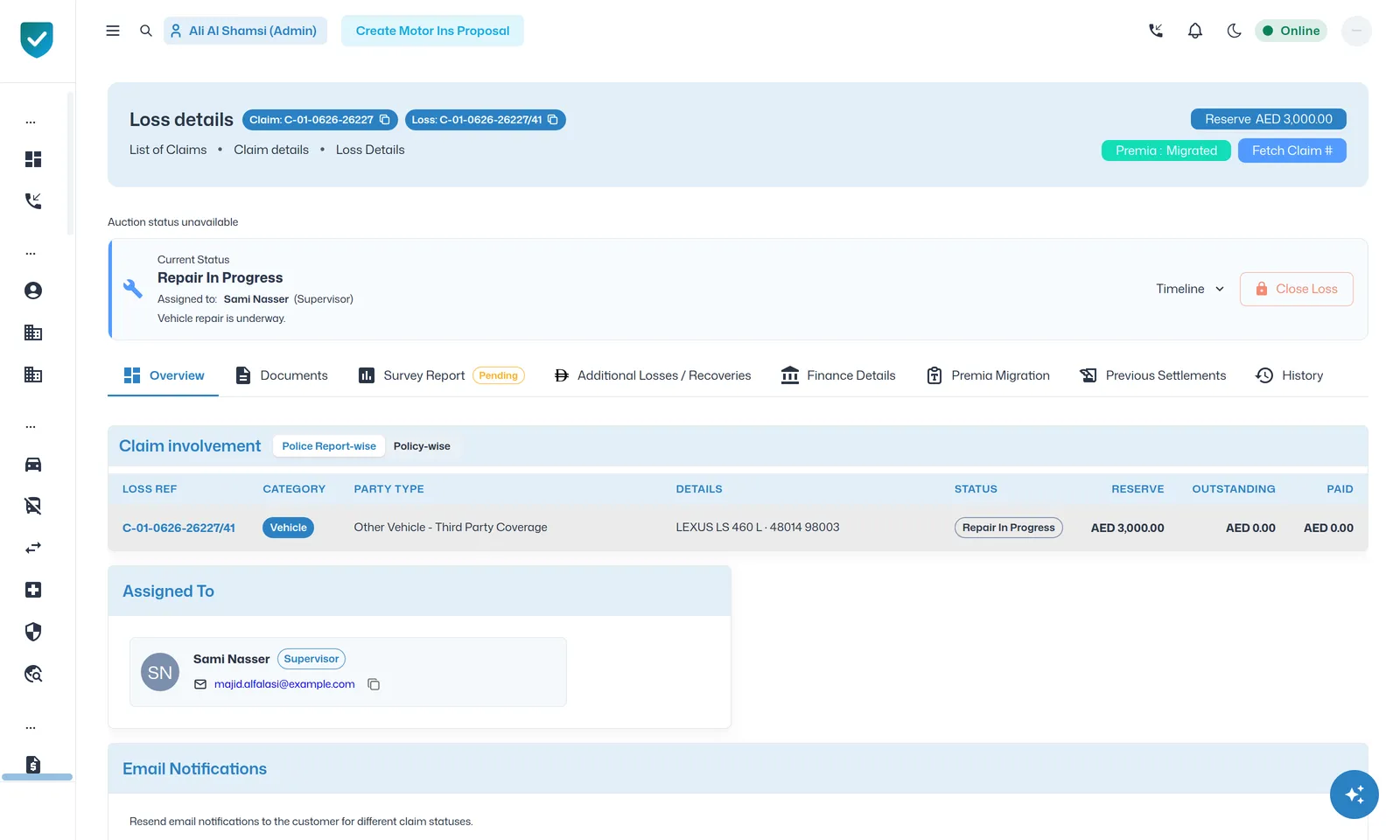 A repair loss with its quotations, approval and purchase order in one file (demo data).
Path two: cash settlement
Some customers prefer money to a repair. The comprehensive wording allows the insurer to pay the loss in cash if this is agreed with the insured. For third parties, the at-fault insurer must pay in cash on the injured party’s request.
A cash settlement looks simple but has its own risks:
- The figure. It comes from the survey and goes through approval like a repair quote. The written explanation of how it was calculated is a requirement, not a courtesy.
- The breakdown. Assessed amount, agreed amount, deductible and any extra excess, VAT where it applies, then the final figure.
- The payee. The bank account should belong to the vehicle owner. If it does not, the insurer needs a no-objection letter and the receiver’s ID on file.
- The switch. A repair can become a cash settlement half-way. If the survey and estimate carry over, nothing is typed twice.
A customer who declines the offer is not the end of the story. Under the unified wording, if the insurer and the claimant disagree on the value of the damage or the compensation, the regulator (originally the Insurance Authority, now the Central Bank of the UAE; see who regulates insurance in the UAE) can appoint a licensed surveyor and loss adjuster to settle the value, at the insurer’s expense.
Path three: total loss and salvage
Under the comprehensive wording, a car is a total loss if it is lost, cannot be repaired, or would cost more than 50% of its pre-accident value to repair. Damage to the chassis, or to load-bearing parts such as pillars that need cutting, tightening or welding, is also treated as a total loss.
Compensation on a comprehensive policy is based on the insured value agreed when the policy was written. The wording deducts 20% depreciation from that value, taking into account the share of the policy period that has passed at the date of the accident. The wording also says the deductible percentages are not applied on a total loss. For a third party’s car, compensation is based on market value at the time of the accident, set by an expert or by averaging three quotes from licensed showrooms.
Once the insurer pays on a total-loss basis, the salvage becomes the insurer’s property. The customer cannot be charged for transferring the title. If the car is mortgaged, the insurer must contact the bank without delay to obtain a no-objection letter. Total loss therefore involves more parties than a repair: the customer, the bank, the storage yard, and finally the buyer of the wreck. Selling the wreck well is a discipline of its own, with reserve prices, dealer vetting and release documents.
Third party, own damage and recoveries between insurers
One accident can create several losses: the insured’s own car, the other car, someone’s property and injured people. Each has different rules.
Third-party property. The third-party wording limits property damage to AED 2,000,000 per accident, whatever the number of people affected. No deductible may be taken from the injured third party’s compensation.
Third-party agency repair. If the third party’s car is in its first year of registration and use and repair is agreed, it must be repaired at the agency. Parts on a car under one year old are replaced with new original parts with no depreciation charged.
Recoveries between insurers. If the third party’s car has its own comprehensive policy with agency repair, that insurer repairs at the agency and recovers from the at-fault insurer. The recovery is reduced by 15% of the final repair bill if the car is between one and two years old, and by 30% if it is between two and three years old.
Loss of use. A private car owner who is a third party can claim a daily allowance for a replacement car, up to AED 300 a day for up to fifteen days, if the car is being repaired. There is no allowance if they choose cash. If they hold their own comprehensive policy, they can claim from their own insurer, which then recovers from the at-fault insurer.
Bodily injury. Third-party liability for death and injury is the amount awarded by the court, with no upper limit, subject to the policy’s specific exceptions.
Recoveries run in both directions. An insurer is owed money by some insurers and owes money to others, often on the same day. Without a clear recoverable and payable list per insurer, this money is easy to lose. Please confirm with your compliance and legal teams how these rules apply to your own policies.
Deadlines, disputes and complaints
Many motor claims complaints are about time: “where is my car?” and “when will I be paid?”. The unified rules above give the core deadlines: three days to request missing documents and fifteen days to settle a complete claim. If a total-loss settlement is delayed beyond fifteen days without convincing reasons, the insurer must also compensate the beneficiary for costs caused by being without the car.
When a customer is not satisfied, the formal route runs through Sanadak, the independent ombudsman unit set up by the Central Bank. Under the Sanadak regulation, Sanadak can turn a complaint away if the customer has not given the insurer at least 30 complete business days to send a final written response. Insurers should track complaints against that window, and keep the written record of their final response.
Fair garage networks
Garages are partners, but work allocation can drift. A few large groups can end up with most of the jobs, through habit or relationships. That creates concentration risk, weakens price discipline and invites questions from auditors.
Fairness is easier to manage when it is measured. Useful measures include:
- each garage group’s share of live repair work, by number of jobs and by value;
- repair cycle time and on-time delivery;
- supplementary requests, their rate and their cost;
- complaints per garage;
- trade licence validity, with expired licences blocking new work;
- grades that limit which brands and vehicle ages a garage may repair.
What to look for in a motor claims system
When you compare systems for motor claims in the UAE, check that:
- One claim can hold several losses, each with its own owner, reserve and clock.
- The survey decision routes the claim and enforces the inputs each path needs.
- Approval limits by amount and role are settings your team controls.
- Garages, loss adjusters and contractors work inside the system, not over email.
- Deadlines are timed in working days with the UAE holiday calendar.
- Recoveries are tracked both ways, per insurer.
- Total losses flow into salvage and sale without re-typing.
- Settled claims post to the ledger without a month-end re-key.
VInsure Motor Claims runs the three paths on one status line. Garages quote, repair and invoice in their own portal. A garage invoice is read and checked for the tax number and the approved amount. A fair-share rule warns the handler when a garage group reaches 15% of live repair work and blocks new quotation requests at 25%. Branches of one business count as one, overrides need a logged reason, and total-loss work is exempt. The claims engine has 13 parts, from the handling core and survey to complaints and AI comment triage. A Central Bank complaint gets critical priority, a locked 3-working-day internal deadline and restricted access. The customer accepts a cash offer from a link and signs on screen, with no app needed.
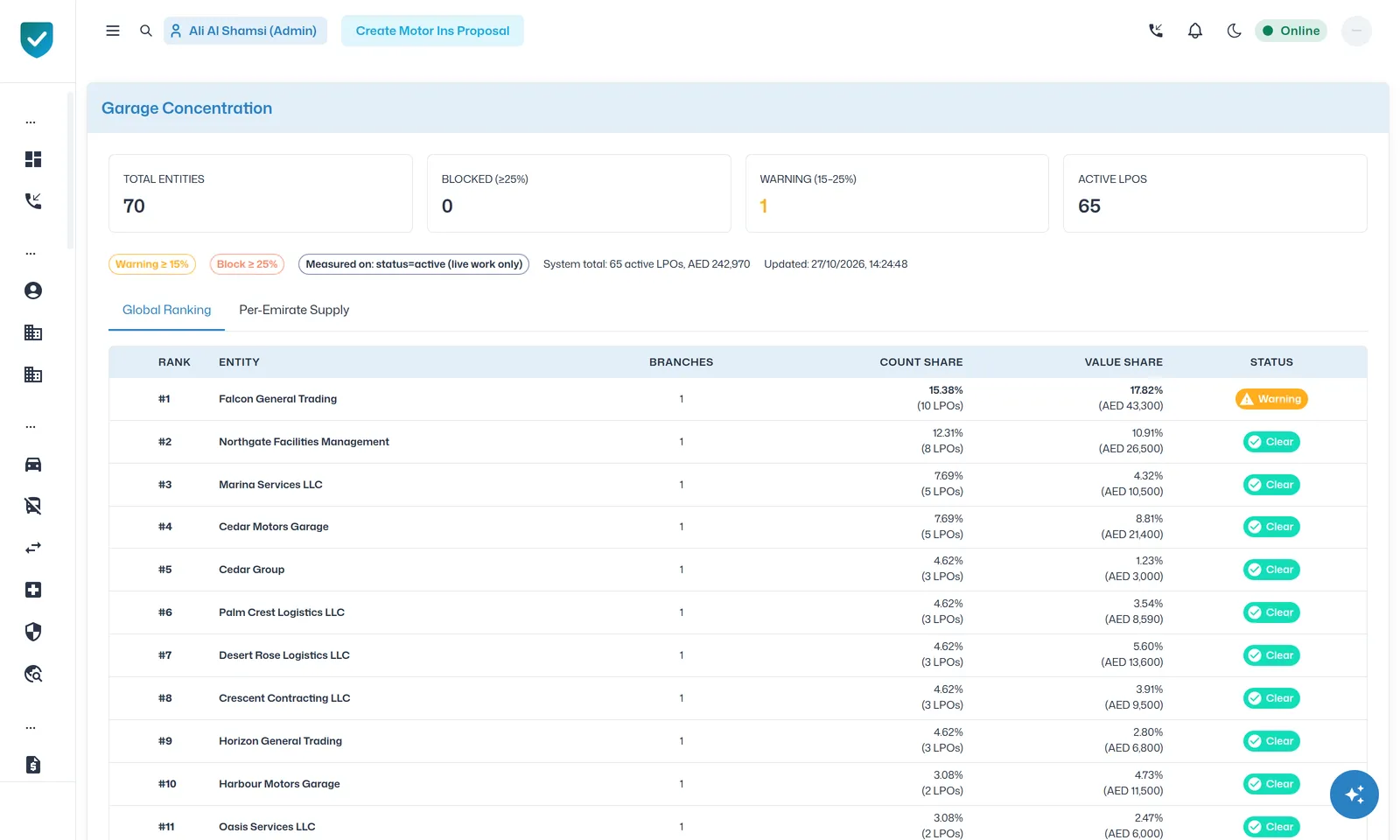 The garage concentration view, with each group’s share of live repair work (demo data).
Total losses move into the Salvage Auction in one click, and the sale comes back as a booked recovery. Motor policies, repair conditions and excess bands come from VInsure Motor, so the claim reads the same policy record. Methaq Takaful runs its claims and garages on VInsure; you can read the case study or book a demo to see the claims flow on the live system.
Questions people ask
How long does an insurer have to settle a motor claim in the UAE?
Under the unified motor policy rules, the insurer must settle a claim within fifteen days of receiving the completed claim documents. If documents are missing, it must tell the claimant in writing within three days of receiving the claim. Total-loss compensation follows the same fifteen-day limit. Your compliance team should confirm how these limits apply to your own claim types.
When is a car a total loss under the UAE unified motor policy?
Under the comprehensive (loss and damage) wording, a car is a total loss if it is lost, cannot be repaired, or repair would cost more than 50% of its value before the accident. Damage to the chassis or to load-bearing parts such as pillars that needs cutting, tightening or welding is also treated as a total loss.
Does a third party have the right to agency repair?
If the third party's car is in its first year of registration and use, and repair is agreed, the at-fault insurer must repair it at the agency. After the first year it may use suitable repair shops for the car's type and age. If the car has its own comprehensive policy with agency repair, that insurer repairs at the agency and recovers from the at-fault insurer on set terms.
Can a motor claim switch from repair to cash settlement?
Yes, if the insured agrees. The comprehensive wording lets the insurer pay the loss in cash when this is agreed with the insured. In a good claims system the switch keeps the survey and estimate, so the handler does not start again and the customer does not repeat their documents.
Where this lives in our products
- Motor ClaimsRun motor claims from first notice to final payout in one system, including garage networks, repair approvals, total loss and salvage recovery.
- Motor & FleetQuote, price, issue and service individual motor, fleet and third-party (TPL) policies in one flow, with UAE data checks built into the sale.
- Salvage AuctionA private, invite-only online auction where insurers sell total-loss and recovered vehicles to vetted dealers, from claim to booked recovery.
Sources
- Insurance Authority Board of Directors' Decision No. (25) of 2016 Pertinent to Regulation of the Unified Motor Vehicle Insurance Policies, Central Bank of the UAE (CBUAE Rulebook) (checked )
- Unified Motor Vehicle Insurance Policy Against Loss and Damage: Chapter Two: Obligations of the Insurance Company, Central Bank of the UAE (CBUAE Rulebook) (checked )
- Unified Motor Vehicle Insurance Policy Against Third Party Liability: Chapter One: General Conditions, Central Bank of the UAE (CBUAE Rulebook) (checked )
- Unified Motor Vehicle Insurance Policy Against Third Party Liability: Chapter Two: Obligations of the Insurance Company, Central Bank of the UAE (CBUAE Rulebook) (checked )
- Unified Motor Vehicle Insurance Policy Against Loss and Damage: Chapter One: General Conditions, Central Bank of the UAE (CBUAE Rulebook) (checked )
- Establishment of an Ombudsman Unit for The United Arab Emirates Regulation, Central Bank of the UAE (CBUAE Rulebook) (checked )
This article explains how things work in general. It is not legal, regulatory, tax or actuarial advice: confirm how a rule applies to your company with your own advisers.

About the author
Tony Naief Al Saiegh, Founder & CEO, VIONEX
Tony was born and raised in Abu Dhabi. He started in design and corporate communications, moved into software eleven years ago, and now leads VIONEX's work on insurance technology for UAE and GCC insurers.